Ryan ALM
White Papers
Pension Confusion - Find the Liabilities
Securing and funding liabilities in a cost-efficient manner with prudent risk is the true pension objective. Although liabilities should be the focus of pensions, it is hard to find liabilities...
Source: Pension Confusion - Find the Liabilities
Securing and funding liabilities in a cost-efficient manner with prudent risk is the true pension objective. Although liabilities should be the focus of pensions, it is hard to find liabilities in asset allocation, asset management and performance measurement… especially forPublic and Multiemployer Plans,as theseplans are asset only focused. Private plans are very much liability driven although they have opted out of pensions to buy Insurance BuyOut annuities as a major trend for over ten years.Given the 500 bps increase in the Fed Funds rate in the last two years, Private plans need to revisit the economics of BuyOut annuities versus a defeasance strategy (cash flow matching). I think they may find that a defeasance strategy has definite cost advantages today.
So, what’s the matter? There is an obvious disconnect between assets and liabilities because liabilities are missing from every critical asset function:
Asset Allocation (AA)
Liabilities are like snowflakes, you never find two alikeas each pension plan has a different labor force, salaries, mortality and plan amendments. There can never be a generic market index to replicate any plan sponsor’s unique liability cash flows. Liabilities are the domain of the actuary. They produce a very thorough annual report detailing and itemizing numerous liability calculations. The actuaries do an amazing job given the huge number of calculations. They have a tedious and most important function as the calculator and custodian of the liabilities. This voluminous work is usually presented as an annual report a few months after the end of the fiscal year. More importantly, the actuary calculates the funded status which should be the focus of asset allocation, asset management, and performance measurement.
Most pension asset allocations are based on earning a target ROA or hurdle rate. The ROA is calculated by weighing the expected return for a series of asset classes. Each asset class has its own ROA based on its index benchmark estimated return. Pension consultants are quite diligent in analyzing each asset class and assigning the proper weight to achieve the target ROA and risk behavior. Thorough quarterly reports are presented by the consultants to plan sponsors detailing the risk/reward of every asset manager versus the index benchmark assigned to that asset class as the bogey. As a result, generic market indexes are the driver and focus of asset allocation.
AA should be responsive to the funded status of each client. A 90% funded plan should have a much more conservative AA than a 60% funded plan. But most, if not all, asset allocation models ignore the funded status and focus on achieving the target ROA with the highest probability of success and prudent risk based on historical returns of a database that is almost 100% generic market indexes. The historical risk/reward behavior of numerous generic market indexes are
inputs into an AA optimization model that provides a baseline allocation of each asset class. The pension consultant will then massage those weights to best fit each client. Too often plan sponsors have similar asset allocations no matter what their funded status is because they have similar ROA targets. This has led to inappropriate AA especially in the late 1990s and early 2000s that were heavily skewed to risky assets although the pension plans were greatly overfunded then. Had pensions defeased their liabilities then through a cash flow matching strategy with investment grade bonds, they could have secured their surplus victory and stabilized low contribution costs. Instead, the equity correction of 2000-02 wrecked the funded status of almost all pensions causing spiking contribution costs which have not subsided even today.
Without knowledge of the economic funded status on a frequent and accurate basis, AA cannot function effectively. If the market value of assets is the most accurate measurement of asset valuation then the same is true for liabilities. The Society of Actuaries (SoA) delivered a research paper “Principles Underlying Asset Liability Management (ALM)” years ago that warns of erroneous accounting valuations and recommends that pensions create a set of economic books:
“A consistent ALM structure can only be achieved for economic objectives. Accounting measures can sometimes distort economic reality and produce results inconsistent with economic value. Because ALM is concerned with the future asset and liability cash flows, the natural focus of ALM is economic value.”
Ryan ALM Translation: Pension plans need to create a set of “economic books” so ALM can function effectively. It’s all about asset cash flows funding liability cash flows. A Custom Liability Index (CLI) is the method and proper benchmark to create economic books.
With a CLI in place, consultants and plan sponsors can now know monthly the true economic funded status and liability growth rate. With a CLI, consultants now possess pertinent and private information for each of their clients that no other consultant would have…. a significant advantage over competition. The CLI allows consultants to now customize the AA to best fit the clients dynamic funded status with timely adjustments. Although the actuaries don’t produce a CLI, it is based on the private actuarial projections of benefits, administrative expenses and contributions. Ron Ryan and his team created the first CLI in 1991 as the true benchmark of a pension. The Ryan ALM CLI provides all of the calculations needed for efficient AA, ALM, and performance measurement.
Asset Liability Management (ALM)
It would be hard, if not impossible, for an asset manager to manage assets versus a generic market index if it came out annually, months after the end of the fiscal year with no transparency (index constituents not shown) and it wasn’t priced at the market. Well welcome to the pension world of liabilities. Liabilities are an annual actuarial calculation that has little or no transparency (projections usually not shown) and is priced at the ROA (GASB) as the discount rate. The ROA discount rate is certainly not a market rate you can buy to settle the liabilities. The ROA discount rate is one of the accounting distortions of economic reality the SoA referenced.
This was the message from the SoA. You need to create a set of economic books for ALM to function effectively. This is why a CLI is the critical step in ALM. Assets need to know what they are funding. The answer is usually net liabilities defined as (benefits + expenses) – (contributions) since contributions are the first source to fund the liability cash flows. Because net liabilities are not calculated in the actuarial report, the CLI should be a requirement to understand the net liability cash flows that asset cash flows must fund. Such net liability cash flows are also monthly which is another calculation made by the CLI.
If the true pension objective is to secure benefits in a cost-efficient manner with prudent risk, then cash flow matching (CFM) must be the proper and best ALM strategy. CFM used to be called dedication and has been a stable approach to pension investing for over 50 years. Bonds are the only asset class with the certainty of its cash flows. That is the intrinsic value in bonds and the reason why CFM should be the core portfolio of any pension. As the funded ratio improves, a higher allocation should be given to CFM to secure more and more benefits while stabilizing the funded ratio and contributions.
Performance Measurement
Once the CLI is in place, it will provide monthly calculations of the net liability growth rate (returns). Total asset growth (returns) versus the total net liability growth rate is the critical performance measurement. If all of the asset managers outperformed their generic market index benchmarks but total asset growth underperformed total net liability growth rate… the plan loses. This lost shows up in higher pension expense (contribution costs) and a lower funded status.
With a liability objective, the terms Alpha and Beta now take on a different perspective. Liability Alpha is the excess return of asset growth rate versus the liability growth rate. Liability Beta is now the portfolio that matches the liability cash flows it is funding. With the CLI, liability Beta is now a Liability Index Fund. Without a CLI, performance measurement is comparing assets versus assets… this is in sharp contrast to the pension objective of assets versus liabilities.
Liability Beta vs. Market Beta
Beta is a term first pioneered by PhD. William Sharpe in his 1970 book “Portfolio Theory and Capital Markets”. Here he introduced his famous capital asset pricing model (CAPM) which...
Source: Liability Beta vs. Market Beta
Beta is a term first pioneered by PhD. William Sharpe in his 1970 book “Portfolio Theory and Capital Markets”. Here he introduced his famous capital asset pricing model (CAPM) which presented the idea that individual investments contain two types of risk: Systematic and Unsystematic risk.
Systematic risk was deemed to be market risk that cannot be diversified away while unsystematic risk was deemed to be the specific risk of that investment (i.e. credit, features, etc.) that can be diversified away through adding other investments to the portfolio. Modern portfolio theory (MPT) shows that unsystematic risks can be removed or reduced through portfolio diversification. The problem that remains is that of market risk.
The Notre Dame fixed income indexes study of 1986 proved that the market risk for bonds is interest rate risk which is quite dominate. Their calculations showed that interest rate risk explained or accounted for 96% plus of the total return for the major bond index aggregates. This study further proved that interest rate is best measured by a yield curve that is well diversified by maturity or duration (term structure). Any bond index that does not have a distinct term structure is not a good measurement of bond market risk.
Through time, it became obvious how difficult it was for active management to consistently outperform a market index as a benchmark (especially after fees). This led to Index Funds as a major asset management style. The growth in this form of asset management has been dramatic especially when including the explosive growth of exchange traded funds (ETFs).
With the advent of Portable Alpha as a strategy, assets are divided into two groups: Alpha and Beta. A Portable Alpha strategy transfers (ports) the excess return (Alpha) over to the Beta portfolio to secure the victory. The Beta portfolio is considered the portfolio that matches the objective as an index benchmark (i.e. Index Fund) and Alpha is considered the portfolio that outgrows (excess return) the index objective.
Given the currentasset liability management(ALM)or liability driven investment (LDI) trends, it has become obvious that the true objective of a pension is to fund a liability schedule unique to each plan sponsor. Since the objective of a pension (and most institutional objectives) is liability driven shouldn’t the terms Beta and Alpha be redefined for any LDI objective. After communication with PhD. William Sharpe years ago, he suggested I qualify my research as Liability Beta and Liability Alpha to distinguish it from market beta and market alpha. I agree, that makes good sense.
Market Beta and Alpha
Most asset managers are given an index bogey or objective that best represents the asset class risk/reward behavior that the client has chosen as the objective of such asset allocation. Asset consultants are quite diligent in selecting and monitoring the asset managers to perform under these index objectives. The goal could be to either match the risk/reward behavior (Beta portfolio or index fund) or outperform the return behavior (earn Alpha). A few good questions here are: if your asset managers earn market Alpha, does that mean they earned liability Alpha? If all asset managers outperformed their index bogey but total assets underperformed liability growth, did the client win or lose? Did asset allocation create value added (Alpha)?
Liability Beta and Alpha
Several strategies exist to match pension liabilities (cash flow matching, duration matching, derivatives, interest rate swaps, etc.). These liability Beta portfolios are to match the liability cash flow schedule (cash flow matching) or interest rate sensitivity of liabilities (duration matching) or both. Liability Alpha is rarely a consideration yet this is how a pension improves its funding status and reduces pension costs (i.e. contributions). In the end, total assets must outgrow total liabilities over time to earn liability Alpha thereby enhancing the funded status and reduce pension costs.
Custom Liability Index
Given any liability driven objective, the proper index benchmark should be a Custom Liability Index (CLI) that best measures the size, shape and risk/reward behavior of these client specific benefit payment schedules. The Ryan ALM CLI is a monthly report that calculates the present value, growth rate and interest rate sensitivity of liabilities. Client liabilities are like snowflakes… you will never find two alike. Only a CLI could accurately represent the true pension objective. It should be obvious thatthe true objective of a pension is to fund their liabilities in a cost-efficient manner with prudent risk. It is difficult, if not impossible, for asset liability management (ALM) to function effectively without proper knowledge of the liability cash flows. In sports, the scoreboard dictates the strategy. The CLI is the pension scoreboard for liabilities. When compared to assets, the plan sponsor knows every month if they are winning or losing the pension game.
Current accounting rules and actuarial practices price liabilities as a zero-coupon bond portfolio at a single discount rate on an annual basis, months delinquent where the liability cash flow schedule (annual projections of benefits) is rarely seen. Moreover, this single discount rate may not be a market rate (GASB for public plans uses the ROA). Could any asset manager perform versus a generic market index if it came out annually, months delinquent where the index portfolio was not transparent and all issues were priced at the same yield? Sounds ridiculous … well, welcome to the current pension liability world we live in.
The Society of Actuaries (SoA) in their 2004 research paper addressed this situation citing that current accounting rules distort economic reality and urged pensions to create a set of economic books that price liabilities at the market on a frequent and accurate basis. Such economic books are best created and maintained as a Custom Liability Index. Indeed, until a Custom Liability Index is installed, the asset side cannot function effectively towards a liability objective. How could an asset allocation model function without correct input as to the true economic Funded Ratio (assets/liabilities) and the size of the economic deficit or surplus (funded status)? How could performance measurement be calculated quarterly without knowledge of the true economic liability growth rate (total return)? How could you match and fund assets to liabilities without a Custom Liability Index?
I designed the CLI over 32 years ago as the best representation and benchmark for any liability objective. The CLI is a monthly report that prices liabilities at the market (using either the Ryan ALM ASC 715 (AA corporates) discount rates or US Treasury STRIPS). The CLI calculates the true economic present value of liabilities and their growth rate so the funded status and performance measurement of assets versus liabilities can both be ascertained.
Lehman Aggregate and Generic Bond Indexes
As the designer of many of the popular Lehman bond indexes (now Bloomberg Barclay’s), I am honored by the acceptance of these bond indexes. However, it should be obvious that they do not behave like liabilities. All of the popular generic bond indexes are rules based. Such rules only use coupon bonds and do not have zero-coupon bonds. Mathematically, the longest duration of any coupon bond is around 17 years today. As a result, such bond indexes could not be a proxy for long duration liabilities or match these liabilities as an index fund. Furthermore, most pensions are weighted to long durations with an average pension fund in the 10 to 15-year average duration area. The Bloomberg Barclay’s Aggregate’s average duration is usually between four to five years … a definite mismatch to pension liabilities cash flow. Even the long Corporate or Credit index cannot match liabilities. It has two distinct rules based problems. First, it has no issues shorter than 10 years in maturity which leaves out a large and most important segment of liability cash flows. Second, it has no issues with durations longer than 17 years. This is an inappropriate proxy for any pension’s liabilities. It is not the average duration you are trying to match and monitor but the entire liability term structure (liability cash flows). Once again only a Custom Liability Index is the proper fit as a liability benchmark.
Liability Beta Portfolio™ (LBP)
If the Beta portfolio is the portfolio that matches the index objective (Index Fund) then given a liability objective, the proper liability Beta portfolio is … the portfolio that matches the liability objective (Liability Index Fund). To be accurate, you must fund each monthly liability payment.
The Ryan ALM LBP is a cash flow matching portfolio that matches and funds monthly liability cash flows chronologically. Our LBP is a cost optimization model that will produce the optimal lowest cost portfolio to fund the target liability cash flows. Our LBP should reduce funding costs by about 2% per year (1-10 year liability schedule = 20% funding cost savings)! Moreover, the LBP will outyield the CLI thereby providing liability Alpha similar to the yield difference which enhances the funded status. The Ryan ALM LBP should also mitigate interest rate risk (similar duration and term structure matching) and reduce pension expense, the volatility of the funded status and contributions.
The intrinsic value in bonds is the certainty of their cash flows. We urge pensions to use bonds for their value… to match bond cash flows that fund liability cash flows. We do not view bonds as performance vehicles or Alpha assets. They are best as liquidity assets to fund liabilities as they come due. By bifurcating liquidity assets from growth assets (Beta vs. Alpha assets) you BUY TIME for the Alpha assets to grow unencumbered. Many pensions use a “Cash Sweep” where they take away income from all asset classes to fund benefits + expenses (B+E). According to S&P 500 data, dividends reinvested accounted for: 47% of rolling 10 years returns since 1940. So let the bond allocation (liquidity assets) fund B+E which will buy time for the Alpha assets to grow significantly more.
“An error is not a mistake until you refuse to correct it” John F. Kennedy
How To De-risk a Pension
Risk is best defined as the “uncertainty” of meeting the client objective. The pension objective is to fund liabilities in a cost-effective manner such that contribution costs remain low and...
Source: How To De-risk a Pension
Risk is best defined as the “uncertainty” of meeting the client objective. The pension objective is to fund liabilities in a cost-effective manner such that contribution costs remain low and stable. Pension plans also want to de-risk their plans over time. The lowest risk assets for a pension are those that match the liability benefit payment schedule with certainty. By definition, Treasury zero-coupon bonds (STRIPS) and annuities would be the lowest risk assets for pension since they have a known future value… but they tend to come at a high cost since they are low yielding (STRIPS) or have high fees (annuities). Given that the pension objective is to secure benefit payments in a cost-efficient manner, then solving for cost while matching and fully funding the liability payment schedule would be the ideal way to de-risk a pension.
A pension liability benefit payment schedule is a term structure or yield curve often referred to as the liability cash flow. In order to match or de-risk each pension liability payment requires a matching cash flow from assets. Only bonds (and annuities) produce a certain cash flow. That is why bonds have been used for decades as the best way to defease, immunize, and de-risk a pension plan.
Problems with Hedges
Duration-matching strategies (Immunization), Interest Rate Swaps, futures, derivatives, risk overlays, etc. are all hedging tools to help assets match the liability growth rate. They are NOT de-risking strategies since they do not match the liability cash flows. Duration matching has several difficult, if not erroneous, data gathering choices it uses:
Average duration of liabilities
Where do you get the average duration of liabilities? Most, if not all, actuarial reports do not provide this calculation. Moreover, they usually do not provide the projected liability benefit payment schedule which you would need to calculate duration. In addition, actuarial reports are, at a minimum, annual reports usually three to six months delinquent so there would be serious delayed information. The duration calculation is at a precise moment in time… like a balance sheet. As time and interest rates change… so will duration. Only A Custom Liability Index (CLI) based on each pension’s unique liability benefit payment schedule could provide an accurate and monthly duration profile.Discount Rates
Since the duration of liabilities changes with interest rates (discount rates) this calculation needs to be refreshed and updated on a frequent and accurate basis. According to pension accounting rules (FAS 158, GASB 67) and federal funding standards (PPA – MAP 21 and spot rates) there is an assortment of discount rates required to price liabilities. Which one is best? The FASB accounting language says it best… you are use a discount rate that settles the liability payments. This means discount rates you can buy to settle or defease the liability payment schedule. ASC 715 comes the closest by using an AA corporate bond yield curve. Treasury STRIPS would be ideal, but no one seems to favor this approach since STRIPS are low yielding causing the present value of liabilities to be higher. The yield difference in these discount rates could be significant. Any difference in yield creates a difference in the calculation of duration and liability growth rates.Generic Bond Indexes
A common proxy for the average duration of liabilities is to use a generic bond market index… usually the Barclay’s long corporate index. Such a proxy creates several erroneous data issues. This index has no bonds shorter than 10 years and no durations longer than 16 years. This certainly does not represent any pension liability schedule even if the average durations were similar. Accounting standards and actuarial practices price liabilities as a portfolio of zero-coupon bonds with a single average discount rate based on the present value of this zero-coupon liability portfolio. There are no generic bond indexes that use zero-coupon bonds as their portfolio. There are no generic bond indexes that use pension discount rates in accordance with FASB, GASB and PPA guidelines. Each pension plan’s liabilities are different and unique to that plan due to a different labor force, salaries, mortality, and plan amendments. There is no way any generic bond market index could represent any pension plan liability term structure.Only a Custom Liability Index could properly represent and measure any pension plan’s liabilities providing all of the critical data calculations needed to de-risk the plan. In 1991, Ron Ryan designed the first Custom Liability Index (CLI). Based on each client’s unique projected liability benefit payment schedule, Ryan ALM produces monthly CLI reports on:
Structure (Present Value, Average Duration, YTM, Price, etc.)Growth Rate (Liability growth for month, year, and since inception)
Interest Rate Sensitivity (PV change in % and $ given rate changes)
Interest Rate Sensitivity
Every 1 year of duration difference between the liability proxy and the actual duration of each plan’s benefit payment schedule would represent a 1% mismatch in liability growth for every 100 bps of discount rate change. In truth, the duration mismatch is more likely to be three to five years rather than one year. Given that pension cost for the actuary, administration, asset managers, and consultant are usually less than 50 bps a year; such a duration mismatch could be very costly representing years of pension cost.
Funding Liabilities
Imagine a 12-year average duration liability benefit payment schedule. It could have many different term structure shapes to come up with an average 12-year average duration. Imagine 100% of the assets in a 12-year duration bond portfolio. If interest rates rose 50 basis points in one-year, total assets and liabilities supposedly would both have a -6% price return (interest rate movement x duration (as a negative number). If they had the same income return = 5% they would match again. However, if the duration matching assets are used to fund liabilities as they come due then a -1% loss (-6% + 5% = -1%) on assets could be funding a short liability which will have a small positive growth rate. So, the assets could be taking a loss each year to fund the next liability payment if interest rates continue to rise. This could get to be a serious costly mismatch if interest rates continue their secular trend to higher rates for the next few years. But the point is……there is no cash flow match here, only a duration match so there is both a funding and interest rate risk!
Derivatives
Interest rate swaps and futures are contracts not assets. There is no cash flow or funds available to make the liability cash flow payments. They are certainly NOT de-risking strategies but hedges vs. the liability growth rate. In fact, these strategies introduce more risk: counter party risk, interest rate risk, non-matching risk of assets purchased (usually equities) vs. liabilities, and leverage. In addition, interest rate swaps and futures have all of the problems associated with a liability proxy data gathering… as listed with duration matching.
Solution: Cash Flow Matching
As stated in the beginning, matching the liability benefit payment schedule (liability cash flow) at the lowest cost is the ideal way to de-risk a pension plan. Ryan ALM built a liability cash flow matching product, named the Liability Beta Portfolio™ (LBP), as a cost optimization model that matches the liability benefit payment schedule at the lowest cost given the investment policy restrictions of our clients.
The LBP provides about a 2% per year funding cost savings (1-15 years = 30%). This is a serious cost reduction and should be a major consideration of any de-risking strategy. Yes, the LBP model has some credit risk but very small since we are using investment grade corporate bonds with a credit filter (no bonds on negative watch list) plus the cost savings provides a large value-added cushion.
The funded ratio should dictate the allocation to bonds. A surplus should have a high allocation to bonds matched to liabilities and vice versa for a deficit funded status. Unfortunately, asset allocation did not respond to the surplus status in the 1990s which led to the US pension crisis. With funded ratios at 120% and above then, why didn’t pensions immunize and secure this victory? Amazingly, instead of increasing their bond allocation in response to a growing funded ratio they reduced it consistently because of low interest rates to the lowest bond allocations in modern history by 1999.
The allocation to bonds should determine how much of the liabilities we can cash flow match (i.e. a 25% bond allocation might fund the next seven years of gross liabilities). Ryan ALMrecommends: funding the next 10 years of Retired Lives on a net liability basis (after contributions). Indeed, current assets fund the net liabilities not the gross liabilities. Our LBP model will calculate with precision the cost to fund liabilities (gross or net) in a cost-effective manner either as a % of total liabilities or liabilities chronologically, as both methods will de-risk the plan gradually. There are advantages for each method.
Since liabilities are funded initially by contributions, using the LBP model to cash flow match net liabilities chronologically may be able to fund more liabilities than you think. Assume that a 20% bond allocation could match the next 10 years of net liability payments chronologically. Based on the Ryan ALM Liability Beta Portfolio™ (LBP) model we show a cost savings of about 20% on cash flow matching the first 10 years of liabilities, in this interest rate environment.
Matching liabilities chronologically should also buy time for the non-bond assets (Alpha assets) to perform and outgrow liabilities. Given time (7-10 years) most non-bond asset classes tend to outperform bonds. Since liabilities behave like bonds there is a high probability that non-bond asset classes could outperform vs. liability growth over an extended time horizon.
Since the pension objective is a cost focus, cash flow matching a % of total liabilities would produce the optimal cost savings since the longer the bond the less it costs given the same future value. Our LBP model is back tested since 2009. Every $1 billion in bonds used in our LBP model could save about $200 million in cost savings on a 1-10 year liability schedule and $400 million on a 1-20 year liability schedule.
Asset Allocation (AA)
Pension consultants and plan sponsors should consider installing an LBP as the core portfolio in asset allocation and as the liquidity assets to fund liability cash flows chronologically. The intrinsic value in bonds is the certainty of their cash flows. Bonds are usually not considered performance assets (Alpha assets) especially vs. pension liabilities which behave like bonds. Cash flow matching liabilities chronologically will buy time for the Alpha assets (non-bonds) to perform vs. liability growth, thereby enhancing the funded ratio. Such excess returns should be transferred over to the Liability Beta Portfolio™ (LBP) to de-risk more and more liabilities… Portable Alpha. Had this portable Alpha discipline been in place during the decade of the 1990s when funded ratios grew to their highest historical levels with true economic surpluses… there would be no U.S. pension crisis today!
Nota Bene (Note Well)
Please note that the definition of risk used in this article is in sharp contrast to the traditional approach produced by the Nobel Prize winner Ph.D. William F. Sharpe back in 1966. Professor Sharpe proposed that risk is the volatility of total returns and that the three-month T-Bill was the default risk-free rate. He developed the Sharpe Ratio as a means of calculating the risk-adjusted return by subtracting the return of the three-month T-Bill from the mean return of the asset(s) being analyzed and dividing the net return by the volatility of the return of the asset(s) in review. For many decades the Sharpe Ratio was the standard measurement of risk-adjusted returns. In 1994 Prof. Sharpe called me and invited me to Stanford to discuss our unique Custom Liability Index data and reports. I had the unique pleasure to meet and debate with one of the finest intellects I have ever met.
I proposed that risk is not a generic measurement but based on each client’s objective. I referenced pensions where every client’s liabilities are different (like snowflakes). As proof, I asked Professor Sharpe what is the risk-free asset for a 10-year liability payment? Professor Sharpe answered… a 10-year Treasury zero-coupon bond. Prof. Sharpe identified that the three-month T-Bill would have 39 reinvestment moments of uncertainty, so there is no way the three-month T-Bill could match a 10-year liability future value with any certainty and would become a risky asset. Our discussion led to Prof. Sharpe re-inventing the Sharpe Ratio in 1994 to include the benchmark objective instead of the three-month T-Bill in the numerator and denominator such that the average return of the asset portfolio is reduced by the average return of the objective (numerator). This net average return is then divided by the standard deviation of the asset portfolio excess return vs. the objective return. This is commonly called today… the Information Ratio.
Ryan ALM Pension Alert Q2’23
Most Asset Allocations for pensions are based on achieving the ROA. The ROA is an annual forecast of asset returns. Each asset class is assigned a ROA then weighted by...
Source: Ryan ALM Pension Alert Q2’23
Spread between ROA and Bonds Narrowest in 20+ Years
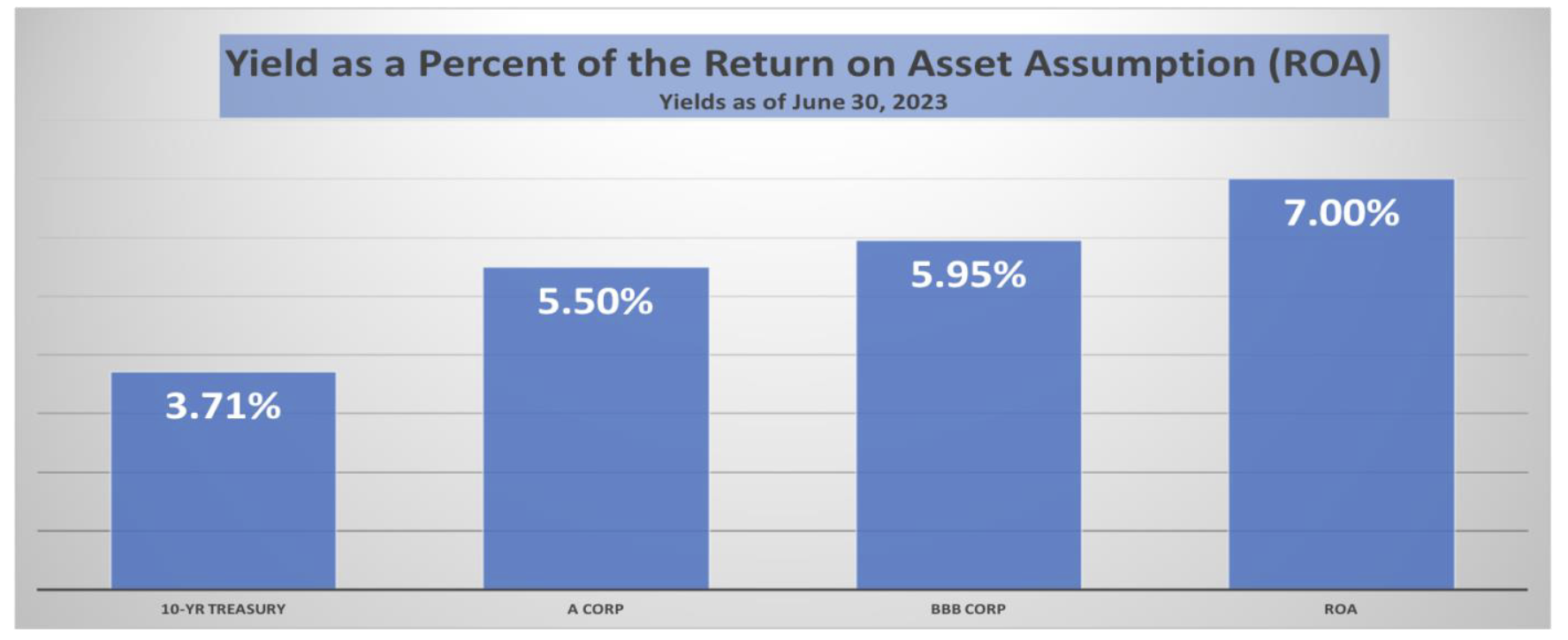
Most Asset Allocations for pensions are based on achieving the ROA. The ROA is an annual forecast of asset returns. Each asset class is assigned a ROA then weighted by the target allocation to get an average or target ROA. Currently, the ROA for most Public pensions is around 7.00%. Yields on A and BBB corporates have risen significantly in the last two years and are now fast approaching the ROA target return. With A and BBB corporate yields at 78.6% to 85.0% of the ROA, a strong argument should be made to increase the allocation to fixed income. The 2023 Milliman Public Funding Survey suggests that the ROA will continue its trend lower. With the Milliman 2024 estimate of a 6.75% ROA, A and BBB corporate bonds would approach 81.5% to 88.2% of the target return. Ryan ALM recommends using bonds for their intrinsic value… the certainty of their cash flows. Cash flow matching liabilities chronologically would be in harmony with the true objective of a pension… to secure the promised benefits in a cost-efficient manner with prudent risk.
Benefits of Higher Bond Allocation to Cash Flow Matching:
Improve Liquidity
Outyield ROA = liability Alpha
Reduce Volatility (risk) of Funded Ratio
Create CORE portfolio as anchor to earning ROA
Reduce costs to fund Benefits + Expenses (B + E)
Buy TIME for performance assets to grow unencumbered
Ryan ALM Pension Monitor YTD 2023
YTD2023 Ryan ALM Pension Monitor (Through June 30, 2023) Pension plan liabilities need to be measured and monitored regularly. Without knowledge of plan liabilities, the allocation of plan assets cannot...
Source: Ryan ALM Pension Monitor YTD 2023
(Through June 30, 2023)
Pension plan liabilities need to be measured and monitored regularly. Without knowledge of plan liabilities, the allocation of plan assets cannot be done efficiently or appropriately. The funded ratio/status of pension plans are present value calculations. Each type of plan is governed by accounting rules and actuarial practices, which determine the discount rate used to calculate the present value of liabilities. Single employer corporate plans are under ASC 715 (FASB) discount rates (AA corporate zero-coupon yield curve); multiemployer plans and public plans use the ROA (return on asset assumption) as the liability discount rate. The difference in liability growth between these plans can be quite significant (see 2022’s differential of 31.5%), which will affect funded status and contribution levels.
The table below compares these different liability growth rates (based on a 12-year average duration) versus the asset growth rate based on the P&I asset allocation survey of the top 1,000 plans which is updated annually.
| ASSET ALLOCATION | YTD 2023 Return | Corporate | Public | Union |
|---|---|---|---|---|
|
Domestic Stock International Stock Global Equity Domestic Fixed Income Global Fixed Income Cash Private Equity Real Estate Equity* Other |
16.9% 12.2% 14.3% 2.1% 1.7% 2.3% 5.8% -5.4% 3.6% |
11.1% 6.1% 6.3% 44.4% 0.9% 2.2% 12.4% 5.5% 11.1% |
22.1% 13.4% 4.5% 19.4% 1.6% 1.6% 15.1% 11.6% 10.7% |
18.7% 9.1% 13.6% 28.9% 0.0% 0.7% 10.7% 9.4% 8.9% |
| TOTAL ASSETS Growth Rate | 5.3% | 7.1% | 7.3% | |
| LIABILITIES Growth Rate** | 4.2% | 3.6% | 3.6% | |
| Asset Growth – Liability Growth | 1.1% | 3.5% | 3.7% |
Index Benchmarks: Domestic Stock = S&P 500; Int’l Stock = EAFE, Global Equity = All Country World; Domestic Fixed Income = BB Aggregate; Global Fixed Income = FTSE World Gov’t (unhedged); Cash = Ryan ALM Cash Index; Private Equity =10-year return for the R2500 + 2%; *Real estate Equity =NFI-DP Index (one month lag); Alternative Investments and Other = CPI-U & 3%.
** Liabilities (corporate) = Ryan ALM ASC 715 discount rate and Liabilities (Public, Multiemployer) = 7.25% ROA
The graph below shows the contrasting annual differences of asset versus liability growth for corporate and public plans since 2015. The impact of different accounting rules (FASB vs. GASB) can create confusion, as reflected in the chart below.
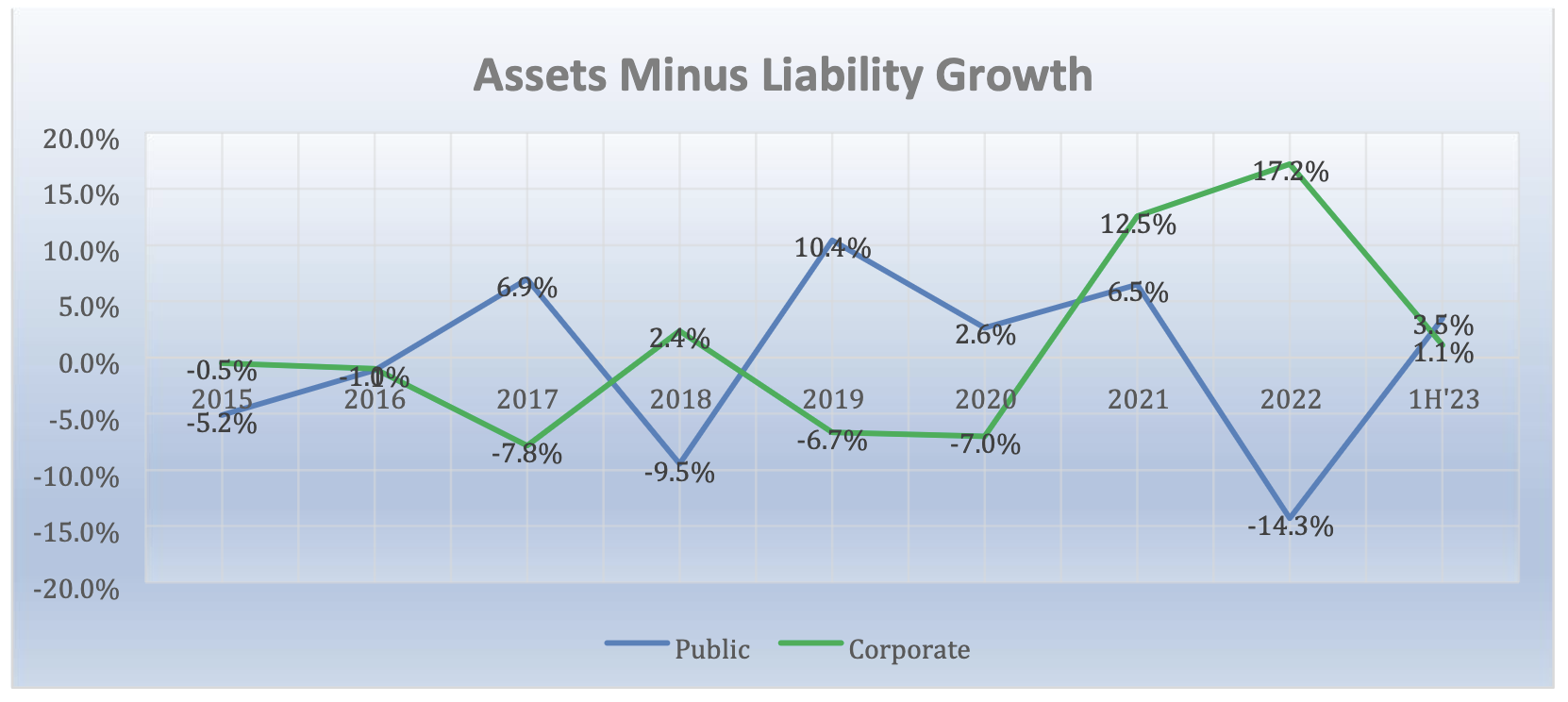
Footnote: The measurement of asset growth to liability growth is an annual calculation beginning on December 31, 2015. For periods shorter than 1-year, the observation is a YTD calculation.
With regard to the first half of 2023, Corporate funding underperformed Public funding as declining interest rates YTD had a slightly greater impact on the present value of a plan’s future benefits. In addition, the much higher exposure to US fixed income within corporate pension plans (44.4%) versus both public (19.4%) and multiemployer (28.9%) and the far less exposure to US equities (11.1%) versus publics (24.4%) and multiemployer (21.8%) had a meaningful impact on the average total return for those plan types.
Ryan ALM Pension Monitor Q1’23
1Q 2023 Ryan ALM Pension Monitor (Through March 31, 2023) Pension plan liabilities need to be measured and monitored regularly. Without knowledge of plan liabilities, the allocation of plan assets...
Source: Ryan ALM Pension Monitor Q1’23
(Through March 31, 2023)
Pension plan liabilities need to be measured and monitored regularly. Without knowledge of plan liabilities, the allocation of plan assets cannot be done efficiently or appropriately. The funded ratio/status of pension plans are present value calculations. Each type of plan is governed by accounting rules and actuarial practices, which determine the discount rate used to calculate the present value of liabilities. Single employer corporate plans are under ASC 715 (FASB) discount rates (AA corporate zero-coupon yield curve); multiemployer plans and public plans use the ROA (return on asset assumption) as the liability discount rate. The difference in liability growth between these plans can be quite significant (see 2022), which will affect funded status and contribution levels.
The table below compares these different liability growth rates (based on a 12-year average duration) versus the asset growth rate based on the P&I asset allocation survey of the top 1,000 plans which is updated each year. The graph below shows the contrasting annual differences of asset versus liability growth for corporate and public plans since 2015. The impact of different accounting rules can create confusion, as reflected in the chart below. Corporations underperformed as declining interest rates increased the present value of a plan’s future benefits.
| ASSET ALLOCATION | Q1’23 Return | Corporate | Public | Union |
|---|---|---|---|---|
|
Domestic Stock International Stock Global Equity Domestic Fixed Income Global Fixed Income Cash Private Equity Real Estate Equity* Other |
7.5% 8.7% 6.8% 3.0% 3.5% 1.2% 3.0% -5.2% 1.8% |
11.1% 6.1% 6.3% 44.4% 0.9% 2.2% 12.4% 5.5% 11.1% |
22.1% 13.4% 4.5% 19.4% 1.6% 1.6% 15.1% 11.6% 10.7% |
18.7% 9.1% 13.6% 28.9% 0.0% 0.7% 10.7% 9.4% 8.9% |
| TOTAL ASSETS Growth Rate | 3.5% | 4.0% | 3.8% | |
| LIABILITIES Growth Rate | 7.2% | 1.8% | 1.8% | |
| Asset Growth – Liability Growth | -3.7% | 2.2% | 2.0% |
Index Benchmarks: Domestic Stock = S&P 500; Int’l Stock = EAFE, Global Equity = All Country World; Domestic Fixed Income = BB Aggregate; Global Fixed Income = FTSE World Gov’t (unhedged); Cash = Ryan ALM Cash Index; Private Equity =10-year return for the R2500 + 2%; *Real estate Equity =NFI-DP Index (one quarter lag); Alternative Investments and Other = CPI-U & 3%.
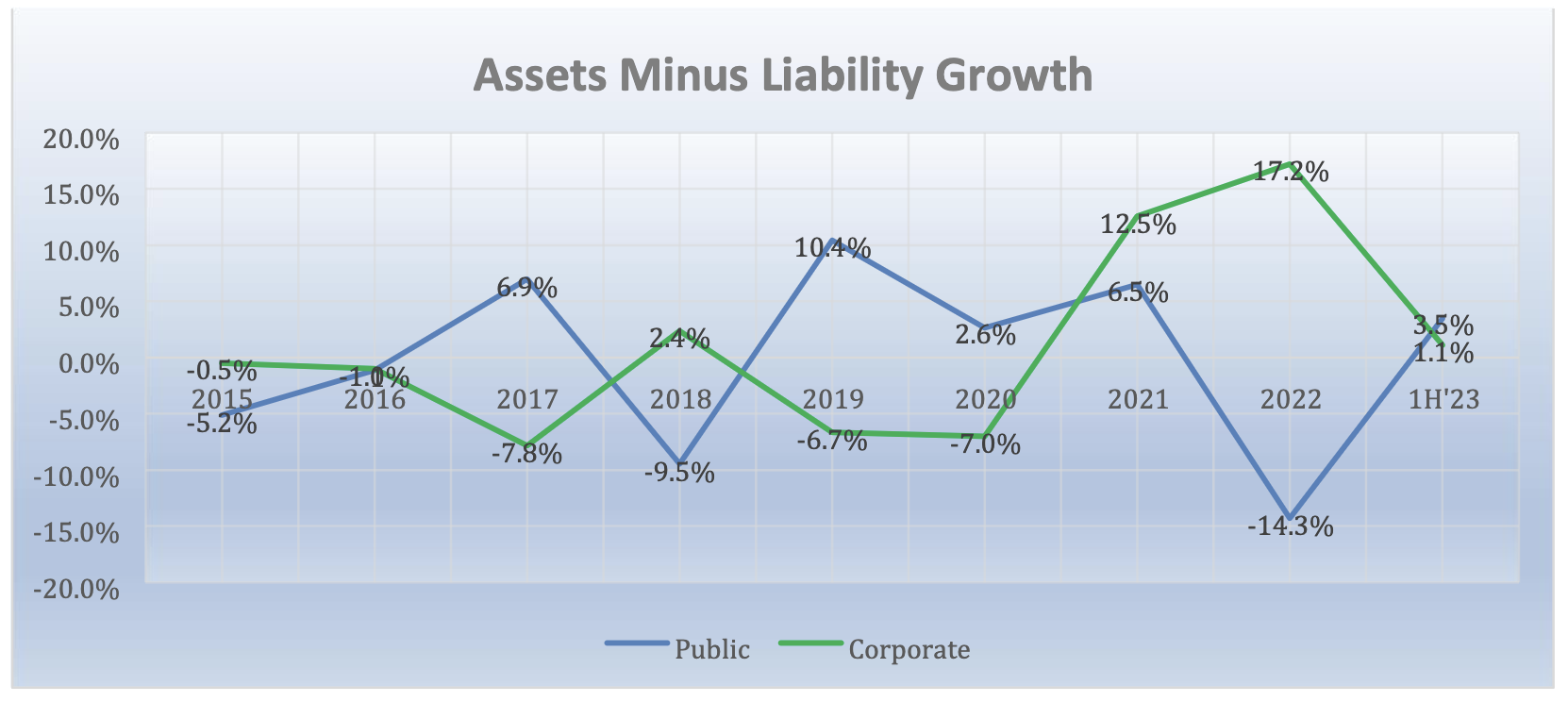
Footnote: The measurement of asset growth to liability growth is an annual calculation beginning on December 31, 2015. For periods shorter than 1-year, the observation is a YTD calculation.
Both Corporate and Public plans had average asset allocations that produced positive results during the first quarter. However, differences in the accounting rules between GASB and FASB led to Corporate plans showing a negative return when comparing assets versus liabilities.
Cash Flow Matching Overview
Cash Flow Matching Pension Objective Fund benefits in a cost-efficient manner with prudent risk Pension Needs Liquidity to fund benefits Reduce Contribution costs Reduce Volatility of Funded Status Strategy Value...
Source: Cash Flow Matching Overview
| Pension Objective | Fund benefits in a cost-efficient manner with prudent risk | ||||||||||||||||
| Pension Needs |
Liquidity to fund benefits Reduce Contribution costs Reduce Volatility of Funded Status |
||||||||||||||||
| Strategy | Cash flow match liability cash flows (benefits + expenses) | ||||||||||||||||
| Value in Bonds |
Certainty of cash flows (only asset class with such value) Maturity selection = yield curve (term structure) Cash flows every month as portfolio |
||||||||||||||||
| Methodology |
Ryan ALM creates a Custom Liability Index (CLI)
Ryan ALM creates Liability Beta Portfolio (LBP)
|
||||||||||||||||
| LBP Benefits |
Fully funds B+E and secures benefits with certainty
Reduces funding costs by 2% per year (1-10 years = 20%)Eliminates cash sweep of growth assets (Alpha assets) Buys time for Alpha assets to grow unencumbered Reduces volatility of funded ratio/status Outyields liabilities creating alpha Enhances funded status and ROA Reduces Contribution costs Mitigates interest rate risk Hedges pension inflation Low fee |
||||||||||||||||
| Note: |
LBP does not change any accounting, actuarial and asset allocation (AA) actions. LBP is a less risky & less costly alternative to active bond management. LBP is a best fit to the true pension objective. |
||||||||||||||||
| Interest Rate Risk (IRR) |
Biggest and dominant risk on bonds present values (PV) Benefits + expenses = future values (FV) B+E are not interest rate sensitive LBP funds Benefits + Expenses LBP mitigates IRR |
||||||||||||||||
| Pension Inflation |
Actuarial projections unique to each pension plan Inflation assumptions =/= CPI |
||||||||||||||||
| Generic Bond Indexes |
Not a proper benchmark Do not represent pension liabilities Liabilities are like snowflakes, unique to each plan sponsor Only a Custom Liability Index could measure/monitor liabilities |
||||||||||||||||
| Value Added |
Ryan ALM offers clients a series of synergistic values:
|
||||||||||||||||
| Awards |
Gold Medal Winner – The U.S. Pension Crisis book of the year Bernstein, Fabozzi, Jacob Levy – Research Paper of the year William F. Sharpe Index Lifetime Achievement Money Management Letter Lifetime Achievement Capital Link – Most Innovative ETF IMN - ETF of the year |
Immunizing Pension Expense Volatility
Pension management is an Assets vs. Liabilities objective. Corporations tend to focus on pension expense since it is a direct hit to earnings and stockholder value. Corporations do not want...
Source: Immunizing Pension Expense Volatility
Pension management is an Assets vs. Liabilities objective. Corporations tend to focus on pension expense since it is a direct hit to earnings and stockholder value. Corporations do not want volatility on earnings coming from pension expense. The major factors affecting pension expense are the dollar growth of assets minus the dollar growth in liabilities. This is in sharp contrast to a % growth difference (ROA of assets – discount rate of liabilities). Pension expense is all about dollars not %. There are two primary liability driven investment (LDI) bond strategies in use today: Duration Matching and Cash Flow Matching.
Duration Matching
The purpose of duration matching is for assets to match the interest rate sensitivity of liabilities (immunization). The objective is to have the market value change (% growth rate) in the immunization bond portfolio match the % growth rate (discount rate) in liabilities for a given change in interest rates. Many LDI fixed income managers attempt to match the average duration of their bond portfolio to the average duration of a bond market index with a similar duration to liabilities (i.e., Bloomberg Barclays long corporate index). They use the bond index as a proxy for liabilities. There are several problems and flaws with this strategy.
A generic bond index cannot replicate any clients’ unique liabilities cash flows. Client’s liabilities are like snowflakes: different labor force, salaries, mortality, etc..
Average durations give erroneous information because there are a numerous number of combinations of maturities for a bond portfolio that can all have the same average duration, but they will not have the same risk/reward profile or interest rate sensitivity.
Duration matching is only accurate for small parallel shifts in the yield curve. But the yield curve rarely moves an equal number of basis points at every point along the curve.
FASB requires a single discount rate for financial statements which does not calculate a proper target duration. You need to use the ASC 715 discount rate yield curve.
LDI bond management evolved to remedy these flaws by using Key Rate durations which attempt to match the duration of multiple points along the liability yield curve. Key Rate duration is an improvement over a single average duration, but still has several deficiencies:
Actuaries usually do not provide the average duration of liabilities and the projected benefits in their annual actuarial report… reason why generic bond indexes are used.
Matching key rate durations of a generic market index = wrong Key Rate durations.
Duration is a present value calculation requiring pricing each projected benefit with a different discount rate (i.e., ASC 715 discount rates yield curve). As a result, 30 annual benefit payments require 30 separate discount rates and 30 key rate durations.
Duration must be modified (duration/1+YTM) to use as a price return or interest rate sensitivity measurement.
Solution: Dollar Duration Matching (DDM)
DDM matches the dollar value change per basis point change in yield for assets with the dollar value change per basis point change in yield for liabilities. When the dollar duration of assets is matched to the dollar duration of liabilities for every year in the term structure of liabilities, then DDM is in its most precise form. That would be the equivalent of 30 Key Rate durations… one at every point along the liabilities yield cure or benefit payment schedule (30 years = 30 key rate durations). Ryan ALM recommends DDM for Active Lives liabilities. The Ryan ALM DDM approach offers several value-added differences:
Actuarial Projections - We use the actuarial projected benefits of our clients and not a generic bond index benchmark.
Modified durations - to be an effective price sensitivity measurement, duration must be modified. Modified Duration measures the percent change in market value or present value for future value cash flows given a 100-basis point movement in yield.
Dollar duration - our objective here is to match the dollar value change per basis point in assets and liabilities in every annual liability maturity or duration.
The Ryan ALM DDM approach greatly improves the accuracy of Key Rate duration matching by matching the dollar value changes in liabilities with the dollar value changes in assets across the liabilities term structure. DDM is in harmony with the corporate objective of immunizing pension expense. The liabilities are measured and monitored by using a Custom Liability Index (CLI) to more precisely calculate the dollar value (PV) movement in assets versus liabilities given any movement in interest rates. The CLI is the most appropriate benchmark for any asset liability management (ALM) and should be the first step in any LDI strategy.
ASC 715 Discount Rates – Ryan ALM is one of few vendors providing ASC 715 discount rates (AA corporate zero-coupon bonds as a yield curve). We will price each actuarial projected benefit payment on a monthly basis.
Custom Liability Index (CLI) - The CLI provides all of the calculations needed for either dollar duration matching or cash flow matching. The CLI will calculate YTM, modified duration, actual growth rate and interest rate sensitivity for each projected benefit as a term structure as well as total liabilities showing both the % and $ change in present values.
Liability Beta Portfolio™ (LBP) – our LBP will dollar duration match or cash flow match projected benefits chronologically using our proprietary LBP cost optimization model that will secure benefits, reduce funding costs significantly as well as immunize interest rate sensitivity.
Solution: Cash Flow Matching (CDI)
Ryan ALM believes that the true objective for a defined benefit pension is to fund and secure benefits when due in a cost-efficient manner. The value in bonds is in the certainty of their known and scheduled cash flows which is why cash flow matching has been used as a major strategy for hedging liabilities for many decades (i.e., dedication, defeasance). It is the matching and funding of benefits (future values) that is the primary focus of cash flow driven investments (CDI). As such, future values are not interest rate sensitive… a major benefit of cash flow matching. Cash flow driven investing (CDI) dominates the way European pensions are managed under IASB accounting standards. Key Rate duration and especially dollar duration matching (DDM) are good for matching present value movements between assets and liabilities but do not focus on funding liability payments (future values). Pensions require liquidity that is sufficient and timely to fund benefits + expenses (B+E). CDI will cash flow match both B+E based on the actuarial projections. CDI is a best fit to fund Retired Lives given their higher degree of certainty. Active Lives might be best served with dollar duration matching (DDM) given the actuarial noise and uncertainty of such actuarial projections.
Since the primary value in bonds is in the certainty of their cash flows, Ryan ALM will cash flow match projected benefit payments chronologically. This provides numerous benefits:
Secures the benefits
Significantly de-risks the plan
Reduces funding costs significantly
Higher yielding bond portfolio than CLI + DDM
Provide adequate and timely liquidity to fund B+E
Reduces volatility of funded ratio and contributions
Buys time for performance assets (Alpha) to grow unencumbered
No interest rate risk since LBP is funding future values (benefit payments)
A major benefit of the Ryan ALM cash flow matching model is the reduction in funding costs by usually 1% per year. If we cash flow match 1-30 years of benefits = 30% cost reduction between the cost of benefits (future value) and the cost to cash flow match (present value). The CDI is skewed to A/BBB+ bonds and longer maturities to reduce funding costs. This will cause the CDI to outyield liabilities by 50-100 bps and DDM. Moreover, the CDI provides adequate and timely liquidity to fund B+E. Many, if not most, pensions do a cash sweep of all asset classes to fund current benefits + expenses. CDI will fund B+E when due which will buy time for the performance assets (Alpha) to grow unencumbered. S&P data shows that dividends reinvested > 50% of the S&P 500 growth in the last 70 years. If interest rates rise, cash flow matching can reinvest any excess cash flows at the then higher yields which will lower funding costs while bonds managed with a purely total return focus would get hurt with lower price returns.
Solution: Duration Enhancing Overlay (DEO)
DDM and CDI cannot hedge 30+ year liabilities well due to the lack of bonds to buy. In a Duration Enhancing Overlay (DEO) strategy, derivatives are used to add duration. The assets in the DDM and CDI portfolios can be used as margin capital for targeted positions in interest rate swaps, swaptions or buy/sell Treasury Futures.
A Duration Enhanced Overlay (DEO) is a zero-investment strategy that can be constructed by taking long only derivatives positions like futures positions in long-dated Treasury bonds, or by taking positions in futures on long-dated treasury bonds while also taking the opposite positions in shorter term Treasury securities.
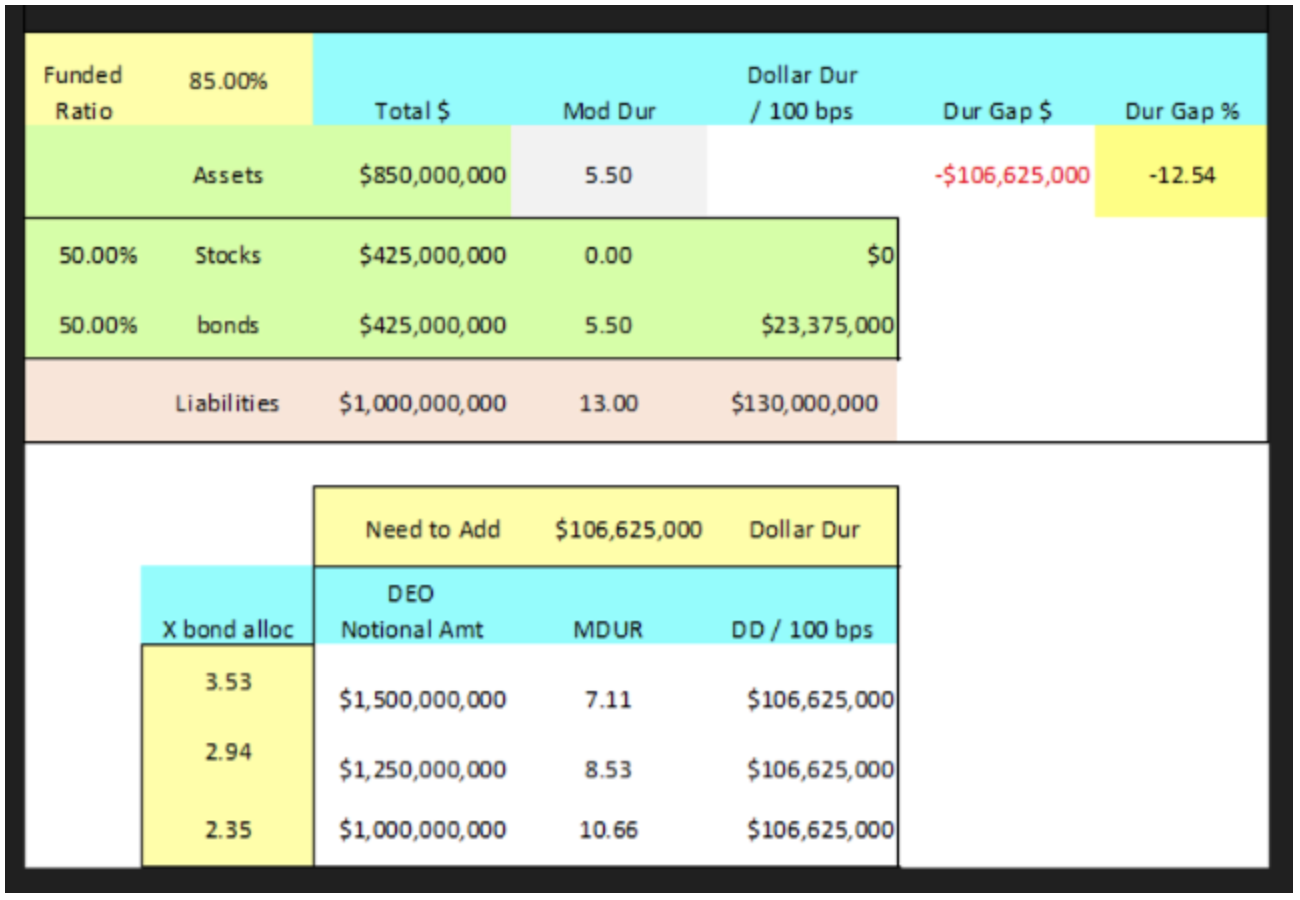
A DEO should be in addition to a CDI or DDM strategy not instead of. The issue becomes the size of the derivative contracts needed to close the duration gap. In the example below, it would take 2.2x to 3.5x the bond position to close the $ duration gap. Ryan ALM cautions against such a strategy as undue leverage but we admit the existence of a dollar duration gap.