

Ryan ALM
White Papers
Browse
What’s Better For a Pension?
Asset returns are uncertain and very volatile. The S&P 500 is a good example. Since 1990 this index has enjoyed 13 years of 20% + growth. Unfortunately, it was accompanied...
Source: What’s Better For a Pension?
Asset returns are uncertain and very volatile. The S&P 500 is a good example. Since 1990 this index has enjoyed 13 years of 20% + growth. Unfortunately, it was accompanied with several negative return years which brought the average 20 year return down to 9.75%:
The decades of the 2000s began with three negative return years for the S&P 500 as follows:
2000 = (9.03%) 2001 = (11.85%) 2002 = (21.97%)
This combined with a secular decline in interest rates made liability growth spike by 55.12% in those three years (according to the Ryan ALM Liability Index) causing funded ratios to drop significantly by as much as 47%. This brings up the commonsense math… if funded ratios go down about 50%, they need to have assets outgrow liabilities by about 100% to get back to full funding. Since the return on assets (ROA) forecast is not based on the funded status but on the expected return of the plan’s asset allocation, the actuarial projections must make up the funded status deficit by increasing contributions. Most pension plans have experienced spiking contributions costs since 2000 which I proclaimed as the primary impetus for the US pension crisis in my 2013 book (The U.S. Pension Crisis). The uncertainty and volatility of the actual ROA has plagued pensions forever and will continue if this remains the focus of asset allocation.
Since the true objective of a pension is to secure benefits in a cost-efficient manner with prudent risk then asset allocation should be focused on this objective and not an ROA objective, which doesn’t guarantee success. This is best accomplished by bifurcating assets into liquidity (Beta) and growth (Alpha) assets. The liquidity or Beta assets should fully fund the liability cash flows (benefits + expenses) chronologically with certainty for as long as the allocation will cover. We define risk as the uncertainty of achieving the objective. So, the least risky asset strategy is to cash flow match (defease) the liability cash flows with certainty. Depending on the plan’s funded status will dictate the asset allocation between the liquidity and growth assets. The funded status is best measured by the
Asset Exhaustion Test (AET) which compares the annual asset cash flows (including contribution) versus the annual liability cash flows (including benefits + expenses).
Ryan ALM recommends starting with an allocation to liquidity or Beta assets that fully funds the liability cash flows for the next 10 years. Then we run the AET to see what ROA is needed for the residual growth assets to fully fund the residual liability cash flows. If the calculated ROA is lower than the current ROA assumption, you can allocate more to the liquidity assets and vice versa.
The benefits of the Ryan ALM cash flow matching strategy (Liability Beta Portfolio™) are numerous and significant:
Reduces risk (de-risks) by cash flow matching liability cash flows with certainty
No interest rate risk since it is funding future values (B+E liability payments)
Provides timely and proper liquidity to fully fund benefits + expenses (B+E)
AET will calculate proper allocation between liquidity and growth assets
AET will calculate ROA needed to fully fund liability cash flows
Reduces funding costs by about 2% per year (1-10 years = 20%)
Reduces asset management costs (Ryan ALM fee = 15 bps)
Reduces volatility of the funded ratio and contributions
Buys time for the Alpha assets to grow unencumbered
No need for a cash sweep to meetliquidity needs
In summary, a LBP cash flow matching strategy for liquidity assets will reduce funding costs by about 2% per year (1-10 years = 20%) while fully funding the liability cash flows with certainty. This will reduce the volatility of the funded status and allow plan sponsors and their consultants to better plan asset allocation for the growth assets. By eliminating a cash sweep, the growth assets can now reinvest their income and enhance their ROA. So, I ask once again: What is better for a pension plan? A 20% asset gain or a 20% liability cost reduction? It is clearly the cost reduction given the certainty of the outcome!
Pension Strategy to Reduce Funding Costs by 20%+
The true objective of a pension is to secure and fully fund benefits in a cost-efficient manner with prudent risk . It is a liability and cost objective… it is...
Source: Pension Strategy to Reduce Funding Costs by 20%+
The true objective of a pension is to secure and fully fund benefits in a cost-efficient manner with prudent risk. It is a liability and cost objective… it is NOT a return objective! This objective is best accomplished through a cash flow matching strategy where an optimal bond portfolio will fully fund monthly benefits + administrative expenses net of contributions. Bonds are the only asset class with certainty of its cash flows. That is why bonds have been the asset choice to defease liabilities for over 50 years.
Cash flow matching (CFM) used to be called Dedication in the 1970s and 1980s. As the head of Fixed Income Research at Lehman in the 1970s and early 1980s, I was in charge of our Dedication model. When I created my initial firm in 1984 (Ryan Financial Strategy Group), I hired the two professors in charge of Dedication at I.P. Sharpe to build our model. At Ryan ALM, we have rebuilt a CFM model that best fits any liability objective. The Ryan ALM CFM strategy utilizes our proprietary cost optimization model that will fully fund monthly net liabilities and reduce funding costs by about 2% per year. If we CFM 1-10 years of net liabilities, we should be able to reduce funding costs by about 20%, 1-15 years = 30%, etc. In addition to reducing funding costs, CFM has several benefits that should be utilized and recognized. We strongly urge pensions to consider CFM as the core portfolio that best fits the true pension objective and provides many additional benefits as listed below:
Cash Flow Matching – Provides Liquidity
The intrinsic value of bonds is the certainty of their cash flows! If bonds were used to cash flow match and fund net liabilities (benefits - contributions) chronologically they would produce the liquidity needed to fully fund such net liabilities. Cash flow matching works best with longer coupon bonds where you use semi-annual interest income cash flows to partially fund liabilities. A 10-year bond has 20 interest cash flows + one principal cash flow all priced at a 10-year yield. This would eliminate the need to do a cash sweep of other asset classes which is a common liquidity procedure. According to S&P data, the S&P 500 has 48% of its historical returns from dividends and reinvestment since 1940 on a 10-year rolling period basis. Wouldn’t you want to reinvest dividends back into growth assets rather than spend it on funding benefits + expenses? Wouldn’t you want the ROA of growth assets enhanced?
Cash Flow Matching - Provides TIME
Ryan ALM, Inc. released a 2022 research report titled “Most Important Asset of a Pension… Time!”. By using bonds as the liquidity assets, the growth assets are left unencumbered to grow. The longer the cash flow matching period, the more time the growth assets have to compound their growth. This could significantly enhance the ROA. By cash flow matching net liabilities chronologically, Ryan ALM can buy the time a plan sponsor and their consultant feel is necessary for the growth assets to grow unencumbered… and recover from negative return years. When markets correct and go down (i.e. 2022) it may take several years to recover and achieve the average annual target ROA that was assigned to that asset class.
Cash Flow Matching – Provides Inflation Hedge
Ryan ALM released a 2020 research report and pension alert titled “Pension Inflation =/= CPI”. Pension inflation has three parts: a cost of living adjustment (COLA) lives; a salary increase factor for active lives and a forecast of administrative expenses. The COLA may be based on the CPI but with a floor and a cap or even a % of the CPI while the salary and administrative expense increases tend to be quite static @ 3% annual increase. As a result, pension inflation tends to be less volatile and more static than the CPI. The plan sponsor actuary includes pension inflation in their projected benefit + expenses payment schedule for both retired and active lives. This fact suggests clearly that the best way (and only way) to hedge pension inflation is to cash flow match the actuarial projected benefits + expenses. If you cash flow match the actuarial projections, you have defeased liabilities and hedged pension inflation.
Cash Flow Matching – Outyields Benchmark and Bond ROA
The Ryan ALM cash flow matching product (Liability Beta Portfolio or LBP) is heavily skewed to A/BBB corporate bonds while the BB Aggregate is heavily skewed to Government bonds. As a result, the LBP will outyield the BB Aggregate by a significant yield spread… usually 50 – 75 bps, which will enhance the ROA of bonds.
Higher Yields are Good for Cash Flow Matching… and Pensions
Ryan ALM released a topical 2022 research report titled “Why Higher Interest Rates are Good for Pensions”. Pension funds are highly interest rate sensitive! Certainly, fixed income assets are such that the longer their maturity and effective duration, the greater their interest rate sensitivity. But it is pension liabilities that are more interest rate sensitive. Liabilities behave like a 100% zero-coupon bond portfolio because the discount rate(s) chosen price liabilities as zero-coupon bonds. This causes liabilities to be longer in duration then the same maturity(s) coupon bonds. Many discount rates are a yield curve of rates (ASC 715, PPA, PBGC, IASB). As interest rates trend higher, bonds can cash flow match liabilities at lower and lower costs. Note that cash flow matching is focused on funding B + E which are future values. Future values are not interest rate sensitive. Bonds are the only asset class with the certainty of cash flows (future values). That is why bonds have always been used as the methodology for defeasance (cash flow matching) of liabilities. Moreover, if interest rates trend upward any reinvestment of cash flow can buy future value at a lower cost. As a result, cash flow matching sees higher interest rates as an opportunity to reduce funding costs. The Ryan ALM cash flow matching product can reduce funding costs by @ 20% for most pension liabilities out to 10 years. In contrast, bonds used as performance or growth assets could see negative returns… like 2022. Total return performance is not the value in bonds… the certainty of cash flow is the intrinsic value. We urge pensions to transfer their bond allocation from focusing on outperforming some generic bond index to focusing on cash flow matching liabilities chronologically, especially at today’s higher rates.
Reminder: The ROA is Plural… ROAs
Ryan ALM, Inc. released a topical 2022 research report titled “The Pension ROA is plural… ROAs” that details how the ROA is calculated. Each asset class is askby using their index benchmark as the target return proxy. However, for fixed income it is the YIELD of the index benchmark… not the total return like other asset classes. The Bloomberg Barclay Aggregate is most favored as the bond index benchmark. This index and almost all popular bond index benchmarks were designed at Lehman Bros. by me (Ron Ryan) when I was the head of Fixed Income Research & Strategy from 1977 to 1983. Please note… each asset class is NOT required to earn the pension fund ROA assumption (@ 6.50% today). This is an important fact to remember in asset allocation. We at Ryan ALM often hear the criticism and question… how can we invest in 4% bonds to earn our ROA? The answer is bonds do NOT need to earn the pension ROA… just their assigned ROA (yield of index benchmark) in the asset allocation model.
The Evolution of Asset/Liability Management
CEO, Ryan ALM, Inc. What Is Asset/Liability Management (ALM)? The objective of most institutions in the United States with assets to invest is to fund some sort of liability, (banks,...
Source: The Evolution of Asset/Liability Management
CEO, Ryan ALM, Inc.
What Is Asset/Liability Management (ALM)?
The objective of most institutions in the United States with assets to invest is to fund some sort of liability, (banks, insurance companies, pension funds, etc.). As a result, asset/liability management (ALM) should be the investment focus and strategy for these institutions.
Banks and insurance companies have maintained this focus because it is required by the regulations under which they operate. The IAIS Standard No. 13 (2006), which is the basis for insurance company regulation in the United States, defines asset/liability management (ALM) as the practice of managing a business so that decisions and actions taken with respect to assets and liabilities are coordinated.1 Oracle Financial Services (2008), in its white paper “Asset Liability Management: An Overview,” defines ALM for banks as a mechanism to address the risk faced by a bank because of a mismatch between assets and liabilities resulting from either differences in liquidity or changes in interest rates.
Indeed, as banks and insurance companies have practiced it, ALM is the management of assets so that asset cash flows are as similar as possible to that of the liability cash flows. Exley, Mehta, and Smith (1997) conclude in their paper “The Financial Theory of Defined Benefit Pension Schemes” that financial theory offers no good reason why ALM as practiced by pensions should differ from ALM by banks. They emphasize that the time has come to stop treating pensions as anything special. Pension liabilities are the same as any other liability. In a special LDI (liability-driven investing) issue of aiCIO Magazine, McDaniel (2011)
IAIS is the International Association of Insurance Supervisors. See http://www.iaisweb.com.
provides a well-documented history of LDI theory in his column “LDI’s Founding Document,” concluding that pension liabilities should be treated in the same way as bank and insurance liabilities, giving each a proper ALM focus.
The focus of this review will be the evolution of ALM for pensions. Pensions have no regulations requiring asset/liability management or the matching of assets cash flows to liability cash flows. This lack of regulation may be the most important cause of the spiraling pension deficits and decline of defined benefit plans since 1999.
Prehistory: Insurance Company Management of Pension Funds
In the decades before pension plan sponsors began to manage pension assets as quasi-independent investment organizations, it was typical for pension plan sponsors to simply pay an insurance company to assume the liabilities of the pension plan. The insurance company was then responsible for investing the assets while complying with then-current insurance regulations. By regulations, the insurance companies invested most of these assets in fixed-income securities, matching the cash flows from the assets to the cash required to be paid to the pension beneficiaries. This trend has existed from roughly 1875 when the first U.S. corporate pension plan (American Express) was established to today.
In the Beginning: Dedication
Dedication was the earliest form of ALM practiced by pension plans as quasi-independent investment organizations. It was in vogue during the historically high-interest-rate environment of the 1970s and early 1980s. Marty Leibowitz was the first to refer to cash flow matching as “dedication” because it required matching a stream of cash inflows (assets) to a stream of cash outflows (liabilities); each cash inflow was “dedicated” to paying a particular outflow. His work was initially published by Salomon Brothers in the 1970s, where he was managing director, and then (1986) as a series in the Financial Analysts Journal under the title “The Dedicated Bond Portfolio in Pension Funds.” Many authors have written about the pros and cons of dedication. Perhaps the most complete set of writings is offered by Frank Fabozzi (2005) in Dedicated Bond Portfoliosin The Handbook of Fixed Income Securities.
As interest rates rose in a long secular trend, the financial industry began to pay attention. Realizing that the high interest rates would allow them to lock in unprecedented rates of return, defined benefit pension fund managers embraced the concepts of dedication and then later immunization. Wall Street
broker/dealers, especially Salomon Brothers, with Marty Leibowitz as its intellectual leader, provided the complicated software models needed to execute dedication and immunization effectively. Many papers promoting and critiquing ALM strategies were written by quantitative scholars during this time. Times were also good for broker/dealers who could execute very large dedication and immunization portfolios. Perhaps the largest bond trades ever recorded were those done for dedication and immunization.
The dedication model assumed a 100% bond portfolio held to maturity. The quest was to find the least expensive collection of bonds that provided the needed cash flows over the time horizon of the liabilities to be funded. Dedication had several distinct advantages:
Simple asset allocation (100% bonds)
Mitigates interest rate risk since it is funding future values
Specificity (asset cash flows must match liability cash flows)
Predictable cash flows (when the bonds are held to maturity)
Structured management (more certain returns with lower fees)
Reduction of risk (interest rates, reinvestment, inflation, and liquidity)
Immunization Introduced as an ALM Strategy
In the 1980s when interest rates started a secular decline immunization became popular, which focuses on matching the interest rate movement of liabilities in present value dollars. The idea is to minimize the volatility of the surplus (the dollar value of assets minus liabilities) by having an asset duration equal to the liability duration. Duration is the present-value-weighted average time to receipt of the cash flows from a security or portfolio. Macaulay (1938), in his book entitled Some Theoretical Problems Suggested by] the Movement of Interest Rates, Bond Yields and Stock Prices in the United States since 1856,2 is credited with introducing the term “duration” and defining it as above. In 1942, Koopmans’s paper “The Risk of Interest Fluctuations in Life Insurance Companies” pointed out that if the duration of the bonds held in a portfolio were matched to the duration of the liabilities those bonds would fund, the effects of interest rate changes could be mitigated or nullified completely (i.e., the portfolio would be immunized).
This effort to define ALM strategies that would protect a portfolio from interest rate changes largely conducted by academics, culminated in a 1952 paper titled “Review of the Principles of Life-Office Valuations” by a nonacademic actuary, F.M. Redington, who worked for a British insurance company. He is credited with introducing the term “immunization” to signify the investment of assets in such a way that the existing business is immune to a general change in the interest rate.
As interest rates began to fall in early 1982, call risk surfaced as a serious impediment to immunization and dedication models, especially for those who ventured into mortgage-backed securities. This call (or prepayment) risk would alter cash flows and maturity structures, with resulting damage to the integrity of immunization and dedication models that depended on the certainty of these cash flows and maturity dates.
Accounting Rules Redirect Pension Asset Management
This FASB standard would help those designing immunization strategies to understand how to match the present value of liabilities. However, for pension expense purposes, the new statement allowed corporations to use the return on assets (ROA) assumption as follows: If the dollar growth in pension assets based on the ROA rate exceeded the pension expense amount, then pension expense would be negative—that is, it would become pension income which would directly enhance earnings. Because corporations are earnings led and not liabilities led, the ROA became the hurdle rate objective for pension assets.
When interest rates went below the ROA assumption rate (around 8%) in the late 1980s, dedication and immunization strategies fell out of vogue because they locked in a return that would not be sufficient to neutralize or overcome pension expense, resulting in a drain on EPS. As a consequence, dedication and immunization were largely replaced by surplus optimization strategies that aimed at the growth of pension assets to outpace liability growth, thereby creating a pension surplus that would reduce or even eliminate contribution costs. Contribution costs were a function of the funded status (the present value of assets minus the present value of liabilities). Any deficit or underfunding (a funded ratio less than 100%) was to be erased through contributions planned out over time so that the pension plan would be fully funded over the life of the liabilities.
The late 1980s and the decade of the 1990s were good times for pensions. With the switch to a surplus optimization strategy, asset allocation models were heavily skewed to equities over bonds because the ROA was now the “bogey,” or investment return benchmark. This asset allocation decision worked out well during this period; equities enjoyed several good years of double-digit returns, resulting in pension surpluses that enhanced EPS (returns above the ROA were an “actuarial gain” line item that increased EPS) and reduced contribution costs. During this period, ALM became a hard sell, given the level of interest rates, the historical return track record of equities, and the resulting financial statement benefits of an ROA hurdle rate. This focus on an absolute return (ROA) rather than on relative cash flows would soon haunt the pension industry and prove fatal to some plan sponsors.
The equity bear market that hit in 2000–2002 became a pension tsunami for several reasons. The correction was quite deep, amounting to a 49% fall in the S&P 500 Index, with the result that pension asset growth underperformed liability growth by as much as 75% on a cumulative basis over those three years. This event led to spiking contribution costs because of crashing funded ratios, an EPS drain from the pension assets underperforming the ROA (actuarial loss), and even insolvency of the plan sponsor, with several companies (notably airlines) filing for bankruptcy because pensions tend to be the largest liability of many firms.
The Society of Actuaries (SOA) became concerned that such an asset/liability disparity occurred as a result of accounting rules and it issued a research paper draft (2004) titled “Principles Underlying Asset Liability Management,” which warned that accounting measures can distort economic reality and produce reports that are inconsistent with economic results. It
further stated that entities that focus on economic value tend to achieve their financial objectives more consistently in the long run. In other words, the SOA promoted ALM on an economic basis (i.e., market value), rather than on an accounting basis, as the proper asset management style.
At that time, corporations were begging for relief from spiking pension contribution costs. Congress responded with the Pension Protection Act (PPA) of 2006. A number of pension experts provided testimony during the several-years-long process of writing the PPA. In my testimony before the ERISA Advisory Council on Employee Welfare and Pension Benefit Plans (2003), I recommended that liabilities should be priced at the market as a yield curve since liabilities are a term structure. In harmony with FAS 87 rules, I reminded them that the discount rate used should be one that settles the liabilities. I further proposed that as an acid test a rule should be created and enforced that reads, “If you cannot buy it, you cannot use it as a discount rate!”
a 24-month moving average of a three-segment yield curve and (
the current spot-rate yield curve. In both options, the yield curve was based on high-quality corporate bonds rather than Treasury bonds. In effect, the PPA raised discount rates which lowered the present value of liabilities, thereby enhancing the apparent funded ratio and lowering contribution requirements.
The FASB was also concerned that existing standards did not communicate the funded status on balance sheets, so in 2006 it issued Statement of Accounting Standards No. 158: Employers’ Accounting for Defined Benefit Pension and Other Postretirement Plans (effective 2007). This communication, usually referred to as FAS 158, clarified that the discount rates used should correspond to the current market value of aportfolio of high-quality zero-coupon bonds whose maturity dates and amounts match the expected future benefit payments. This accounting standard also introduced Other Post-Employment Benefits (OPEB) liabilities onto the balance sheet, revealing that they are one of the largest liabilities facing U.S. institutions.
ALM Strategies Reborn as LDI
After the equity correction of 2000–2003, the stage was set for institutions to return to the basic practice of asset/liability management, because failure to do so had resulted in deteriorating funded ratios, large actuarial losses, spiking contribution costs and even bankruptcies. This time, however, ALM was more frequently referred to as liability-driven investing (LDI) to suggest a new, enhanced approach.
Because of the ongoing secular trend toward lower rates and the fact that the expected return on assets continued to be used to calculate pension expense, corporations continued to pursue an asset allocation away from bonds but with less equity concentration. This trend opened the asset allocation door to many new asset classes and strategies, including hedge funds, alternative investments, and new LDI strategies.
Frank Fabozzi, Ph.D. and I have written prolifically on ALM strategies and considerations. Fabozzi’s books are a mainstay for any ALM practitioner. His Bond Portfolio Management (especially the chapter “Managing Funds Against Liabilities”), published in 2001, and his Handbook of Fixed Income Securities (chapter on “Cash Flow Matching”), published in 2022, have become required reading. Fabozzi and I teamed up in 2005 to produce the article “Reforming Pension Reform,” proposing a solution to the growing pension crisis. Our solution starts with pricing liabilities at the market (economic value) and then building a custom liability index as the proper benchmark for pensions (or any liability-driven objective), because liabilities are unique to each pension plan. We later followed this article with “Liability Index Fund: The Liability Beta Portfolio” (2011), in which we argued that a liability index fund should bethe core portfolio and is the only correct beta portfolio for a pension with a liability objective. The liability beta portfolio is the proper form of ALM or LDI which cash flow matches liability cash flows at low cost. To create and maintain such a portfolio, a custom liability index is also required.
Waring and Siegel produced a detailed account of why saving defined benefit pension plans is a good idea in their 2007 paper “Don’t Kill the Golden Goose! Saving Pension Plans.” They conclude that the first element needed to manage a defined benefit plan is an “economic” view of the liability. The only risks that can be hedged through investment policy and strategy are those that are correlated with market returns of one kind or another. Accounting values are not hedgeable because they are smoothed and are not market values. In the face of a trend toward freezing defined benefit plans in favor of defined contribution plans, the authors argued that defined benefit plans are more cost effective and efficient than defined contribution plans.
Public pensions have the largest deficits and the lowest funded ratios, a result that may be attributable to the Governmental Accounting Standards Board (GASB) accounting rules, which smooth assets over five years and price liabilities at a ROA discount rate. Since 1999, this accounting practice has usually overvalued assets and undervalued liabilities versus economic values (market values). In my paper “The Public Pension Crisis” (2011), I described how the ROA discount rate misled pension trustees and consultants into making inappropriate asset allocation, benefit, and contribution decisions by thinking they were highly funded when they had true large economic deficits. All of these decisions are linked together. My solution to the public pension crisis starts with liabilities. I argued that until a Custom Liability Index (CLI) is installed as the proper benchmark priced as a yield curve of market rates, all asset allocation, budget, and contribution decisions are in jeopardy.
In conclusion, the true objective of a pension plan is to secure the benefits in a cost-efficient manner with prudent risk. This is best accomplished thru cash flow matching of the liability cash flows. A Custom Liability Index should also be installed as the proper benchmark so asset allocation can know the true economic funded status and performance measurement of asset growth versus liability growth can be accurately assessed.
“Insanity is doing the same thing over and over again and expecting different results” - Albert Einstein
Bibliography
Black, Fischer. 1980. “The Tax Consequences of Long-Run Pension Policy.” Financial Analysts Journal, vol. 36, no. 4 (July/August):21–28.
“I believe that every tax-paying firm’s defined benefit pension fund portfolio should be invested entirely in bonds (or insurance contracts). Although the firm’s pension funds are legally distinct from the firm, there is a close tie between the performance of the pension fund investments and the firm’s cash flows. Sooner or later, gains or losses in pension fund portfolios will mean changes in the firm’s pension contributions. Shifting from stocks to bonds in the pension funds will increase the firm’s debt capacity, because it will reduce the volatility of the firm’s future cash flows. Shifting from stocks to bonds will give an indirect tax benefit equal to the firm’s marginal tax rate times the interest on the bonds.” (p. 21)
Choie, Kenneth S. 1992. “Caveats in Immunization of Pension Liabilities.” Journal of Portfolio Management, vol. 18, no. 2 (Winter):54–69.
“Immunization requires that the value of assets and the present value of liabilities be the same, and that the interest rate sensitivity or duration of the assets be the same as that of the liabilities. The first issue in immunization is establishment of the appropriate discount rates to compute the present value and the duration of a liability schedule. The question of the appropriate discount rates for a given liability schedule has crucial ramifications for construction of an asset portfolio to immunize the liability stream.” (p. 54)
Collie, Bob. 2012. “LDI’s Journey toward Greater Customization.” aiCIO Magazine, vol. 4, no. 4 (LDI Special Issue):6–11.
“The basic initial steps of an LDI program are an increase in the portfolio’s sensitivity to interest rates and a reduction in equity holdings. These steps are similar no matter who is taking them. However, as the LDI program becomes more advanced and the link between the asset portfolio and the liabilities becomes stronger, a point is reached at which a greater degree of customization becomes necessary.” (p. 6)
Ehrentreich, Norman. 2009. “The Asset Return–Funding Cost Paradox: The Case for LDI.” Ehrentreich LDI Consulting & Research.
“Pension regulations of the 1980s have effectively removed incentives for corporate plan sponsors to overfund their pension plans. Now, equity based investing strategies sooner or later lead to large funding shortfalls, and the inability of most plan sponsors to close them immediately makes them persistent. Therefore, the most basic requirement for converting eventual higher asset returns into lower funding costs, i.e., having average funding levels of 100% or more, is regularly violated by most pension plans.” (p. 1)
Fabozzi, Frank. 2005a. “Dedicated Bond Portfolios.” In TheHandbook of Fixed Income Securities. 7th ed. New York: McGraw-Hill:1103–1117.
“The dedicated bond portfolio, as it is frequently called, is a strategy that matches monthly cash flows from a portfolio of bonds to a prespecified set of monthly cash requirements of liabilities. Cash matching or prefunding these liabilities leads to the elimination of interest-rate risk and the defeasance of the liability. Applications for the dedicated strategy include pension benefit funding, defeasance of debt service, municipal funding of construction takedown schedules, structured settlement funding, GIC matching and funding of other fixed insurance products.” (p. 1103)
Fabozzi, Frank, and Ronald Ryan. 2005. “Reforming Pension Reform.” Institutional Investor (January):84–88.
“Until pension liabilities are priced at the market, pension funds run the risk of an asset-liability disconnect. Liabilities should be priced off of a market yield curve. An ironclad pension accounting rule should be: If you cannot buy it, you cannot use it as a discount rate. Start with the Treasury zero-coupon yield curve. Use this yield curve to build custom liability indexes for each plan. Once a plan sponsor creates a custom index as a benchmark for liabilities, it can properly manage assets. Asset allocation and performance measurement models will be able to compare the growth and risk behavior of assets and liabilities by term structure. If assets are not measured against liabilities, they are likely to have the wrong index objective.” (p. 88)
Fabozzi, Frank, and Ronald Ryan. 2011. “Liability Index Fund: The Liability Beta Portfolio.” Journal of Financial Transformation, vol. 33 (December):29–33.
“For corporate defined benefit plans, only a CLI [custom liability index] is the appropriate asset benchmark for liability-driven objectives. With a CLI, Beta and Alpha portfolios are redefined and can work in harmony with the true objective. The asset management guidelines of a pension plan can then take into account the risk/reward behavior of the true economic objective in establishing investment policy, especially the liability Beta portfolio which should be installed as the core portfolio.” (p. 33)
“By definition, an index fund is the correct Beta portfolio that matches the index benchmark with such accuracy that the tracking error is nil with the Beta calculation at 1.00 and the correlation at or near 100. With a liability-driven objective, only a liability index fund could qualify as the Beta or matching portfolio. A liability index fund, by definition, requires an index that reflects a pension fund’s liability term structure. Since each liability structure is unique, this calls for the creation of a custom liability index (CLI). Until the asset portfolio’s cash flows match each monthly liability payment (i.e., liability term structure), the interest rate risk (systematic risk) that dominates the risk/reward behavior of pension liabilities cannot be hedged.” (p. 31)
Financial Accounting Standards Board. 1985. “Statement of Financial Accounting Standards No. 87: Employers’ Accounting for Pensions.” FASB
“Interest rates vary depending on the duration of investments; for example, U.S. Treasury bills, 7-year bonds, and 30-year bonds have different interest rates. … The disclosures required by this Statement regarding components of the pension benefit obligation will be more representationally faithful if individual discount rates to various benefit deferral periods are selected.” (paragraph 199)
“In making those estimates, employers may also look to rates of return on high-quality fixed-income investments currently available and expected to be available during the period to maturity of the pension benefits.” (paragraph 44)
Financial Accounting Standards Board. 2006. “Statement of Financial Accounting Standards No. 158: Employers’ Accounting for Defined Benefit Pension and Other Postretirement Plans.”
“The objective of selecting assumed discount rates is to measure the single amount that, if invested at the measurement date in a portfolio of high-quality debt instruments, would provide the necessary future cash flows to pay the accumulated benefits when due. Notionally, that single amount, the accumulated post-retirement benefit obligation, would equal the current market value of a portfolio of high-quality zero-coupon bonds whose maturity dates and amounts would be the same as the timing and amount of the expected future benefit payments.” (paragraph 144a)
International Association of Insurance Supervisors. 2006. “Standard on Asset-Liability Management.” IAIS Standard No. 13
“This paper describes best practices for asset-liability management (ALM) that a well-managed insurer would be expected to follow and identifies 11 minimum requirements. Asset-liability management (ALM) is the practice of managing a business so that decisions and actions taken with respect to assets and liabilities are coordinated. The objective of ALM is not to eliminate risk. Rather, it is to manage risks within a framework that includes self-imposed limits. The IAIS requires that insurers have in place effective procedures for monitoring and managing their asset-liability positions to ensure that their assets and investment activities are appropriate to their liability and risk profiles and their solvency positions.” (pp. 3, 5, 6)
Leibowitz, Martin L. 1986a. “The Dedicated Bond Portfolio in Pension Funds—Part I: Motivations and Basics.” Financial Analysts Journal, vol. 42, no. 1
“Dedicated bond portfolios allow a corporate pension fund to take advantage of favorable fixed income markets and the actuarial system’s willingness to provide special benefits for a minimum-risk investment approach. Purely as an investment approach, a dedicated portfolio serves as a least-risk asset, minimizing the risks involved in fulfilling a large class of nominal-dollar liabilities. Because the process is largely assumption-free, it provides the sponsoring corporation with an actuarially acceptable way to take advantage of available market interest rates to improve funding status.” (p. 68)
Leibowitz, Martin L. 1986b. “The Dedicated Bond Portfolio in Pension Funds—Part II: Immunization, Horizon Matching and Contingent Procedures.” Financial Analysts Journal, vol. 42, no. 2
“Immunization, horizon matching and various contingent schemes offer pension plan sponsors and managers an opportunity to minimize risk while retaining some degree of management discretion to pursue lower costs or higher returns. Immunization calls for the creation of a portfolio of bonds whose value coincides with the present value of a given schedule of liabilities and whose duration, or interest rate sensitivity, is the same as that of the liabilities. By specifying a minimum portfolio return somewhat below the available market rate, the manager can create a “cushion spread” that provides the basis for several contingent schemes. As long as the portfolio retains assets sufficient to meet the target return, it may be actively managed. When adverse market moves threaten this return, the portfolio must be converted into a dedicated mode that will assure the target return.” (p. 47)
Macaulay, Frederick R. 1938. Some Theoretical Problems Suggested by the Movement of Interest Rates, Bond Yields and Stock Prices in the United States since 1856. New York: National Bureau of Economic Research.
“The time to maturity is not an accurate or even a good measure of ‘duration.’ ‘Duration’ is a reality of which ‘maturity’ is only one factor. Whether one bond represents an essentially shorter or an essentially longer term loan than another bond depends not only upon the respective ‘maturities’ of the two bonds but also upon their respective ‘coupon rates’ and under certain circumstances, on their respective ‘yields.’ Only if maturities, coupon rates and yields are identical can we say, without calculations, that the ‘durations’ of two bonds are the same. The duration of a stream of payments may be thought of as the average life of the stream.” (p. 45)
McDaniel, Kip. 2011. “LDI’s Founding Document.” aiCIO Magazine, vol. 3, no. 2 (LDI Special Issue)
“The history of a formal LDI theory is littered, it seems, with false starts. Our conclusion is that, although historically a distinction has been drawn between asset and liability management by banks and pension funds, financial theory offers no good reason for this distinction. Time to stop treating pensions as anything special. They’re the same as any other liability—and time to show that on the balance sheet.” (pp. 8, 9)
Oracle Financial Services. 2008. “Asset Liability Management: An Overview.” Oracle White Papers (http://www.oracle.com/us/industries/financial-services/045581.pdf).
“Asset Liability Management (ALM) can be defined as a mechanism to address the risk faced by a bank due to a mismatch between assets and liabilities either due to liquidity or changes in interest rates. Apart from liquidity, a bank may also have a mismatch due to changes in interest rates as banks typically tend to borrow short term (fixed or floating) and lend long term (fixed or floating). The function of ALM is not just protection from risk. The safety achieved through ALM also opens up opportunities for enhancing net worth.” (p. 2)
Ryan, Ronald. 2003. “Testimony before the ERISA Advisory Council on Employee Welfare and Pension Benefit Plans.” U.S. Department of Labor
“Liabilities should be priced at the market as a yield curve. A rule should be created, or enforced, that reads: If you cannot buy it, you cannot use it as a discount rate! Bond indexes are market-weighted; they’re not liability weighted. Until a custom liability index is built for each pension plan, based upon the unique actuarial term structure of that plan, and priced off of real zero-coupon bonds, pensions are in jeopardy of managing to the wrong objective.” (p. 9)
Ryan, Ronald. 2011. “The Public Pension Crisis.” IMCA Investments and Wealth Monitor
“The solution to the public pension and budget crisis starts with liabilities. Until a custom liability index (CLI) is installed as the proper benchmark, all asset allocation, asset management, benefit and contribution decisions will be based upon erroneous and misleading calculations. The benchmark must be a CLI because no two pensions are alike due to different salaries, mortality and plan amendments.” (p. 30)
Society of Actuaries. 2004. “Principles Underlying Asset Liability Management.” SOA Exposure Draft
“Asset Liability Management is the ongoing process of formulating, implementing, monitoring, and revising strategies related to assets and liabilities to achieve financial objectives, for a given set of risk tolerances and constraints. A consistent ALM structure can only be achieved for economic objectives. Various accounting measures are affected by rules that change the emergence of income and the reported book value of assets and liabilities. These measures can sometimes distort economic reality and produce results inconsistent with economic value. Because ALM is concerned with the future asset and liability cash flows, the natural focus of ALM is economic value. Entities that focus on economic value tend to achieve their financial objectives more consistently in the long term.” (p. 6)
Waring, M. Barton, and Laurence B. Siegel. 2007. “Don’t Kill the Golden Goose! Saving Pension Plans.” Financial Analysts Journal, vol. 63, no. 1
“The first element of ‘new’ technology needed to manage DB plan risk and cost is an economic view of the liability. The only risks that are helpful to know about are the risks that can be hedged through investing the assets. Such risks are those in the liability that are market related—that is, correlated with the returns of assets or indices available in the markets. Therefore, sponsors need to set aside the actuarial and accounting views of the liability and rediscount the cash flows at appropriate, market-related rates. Plus, they need to understand how these market-related values, economically sensible measures of periodic pension cost, and economically required contributions change as market interest rates change.” (p. 36)
Waring, Barton, and Duane Whitney. 2009. “An Asset–Liability Version of the Capital Asset Pricing Model with a Multi-Period Two-Fund Theorem.” Journal of Portfolio Management, vol. 35, no. 4 (Summer)
“The authors present a new capital asset pricing model (CAPM) that incorporates investors’ deferred spending plans, or ‘economic liabilities’—the underlying purpose behind all investments—and thus reveal a new risk-free asset, the investor’s liability-matching asset portfolio.” (p. 111)
Optimizing Asset Allocation
The asset allocation decision is the single most important asset decision since it affects all assets and the funded status of a pension plan. Strategic asset allocation (AA) takes a...
Source: Optimizing Asset Allocation
The asset allocation decision is the single most important asset decision since it affects all assets and the funded status of a pension plan. Strategic asset allocation (AA) takes a long-term view and establishes weights for each asset class in order to achieve the highest probability of earning the target return on assets (ROA). These weights tend to be static and not responsive to the funded status. Tactical AA is a short-term view that changes the strategic weights due to a market opportunity it is trying to capture. Responsive AA is when AA responds to the ever-changing funded ratio and funded status. Since the true objective of a pension is to secure benefits (liabilities) in a cost-efficient manner with reduced risk over time… responsive AA is the more appropriate methodology.
It should be obvious that a 60% and a 90% funded plan should have two very different asset allocations. But if they have the same or similar ROA they will have the same or similar strategic or tactical asset allocations. Focusing on the ROA has misled most plan sponsors down a return objective path instead of a liability objective direction. This ROA focused road has been a roller coaster of volatile funded ratios and spiking contribution costs.
Responsive AA requires accurate and current knowledge of the true economic funded status (assets MV / liabilities MV and assets MV – liabilities MV). This is difficult due to annual accounting and actuarial reports that are usually months delinquent and don’t calculate the economic market value of liabilities (i.e., GASB accounting). Assets need to know what they are funding (benefits + expenses). Assets need to outgrow liabilities to enhance the funded status, so assets need to know the market value and growth rate of liabilities. Assets need a scoreboard of asset growth vs. liability growth that is updated frequently to help them play the pension game.
Custom Liability Index (CLI)
The solution to the accounting and actuarial delinquent information is a Custom Liability Index (CLI). In 1991, Ron Ryan and his team invented the first CLI as the best representation of the true client objective. Although funding liabilities is the true objective, liabilities tend to be missing in action in asset allocation, asset management, and performance measurement. The reason for this disconnect is the absence of a Custom Liability Index (CLI) that monitors the present value, term structure, and risk/reward behavior of liabilities. Once a CLI is installed as the proper benchmark, then and only then can the asset side function effectively on asset allocation, asset management, and performance measurement.
Liabilities are like snowflakes… you will never find two alike. Pension liabilities are unique to each plan sponsor. As a result, only a Custom Liability Index could ever properly represent or measure these unique liabilities of any plan sponsor. A CLI should be calculated accurately and frequently so the plan sponsor and its consultant can be informed with timely data that can support the asset allocation decision. Assets need to know what they are funding. The economic truth is… assets fund the net liabilitiesafter contributions. Our CLI will provide both a gross and net liability valuation based on market rates (ASC 715 and Treasury STRIPS) as well as the discount rates that apply (ROA, ROA bifurcated with 20-year munis, PPA spot rates, and PPA 3-segment). The CLI will provide a monthly or quarterly calculation of the current present value of liabilities so the funded ratio and funded status can be updated… and a monthly or quarterly calculation of the liability growth rate so performance measurement of total assets vs. total liabilities can be assessed.
Since current assets fund net liabilities after contributions, current assets need to know the projected benefits, expenses, and contributions for every year as far-out as the actuary calculates such projections. Noticeably, contributions are a missing asset in the calculation of the funded ratio / funded status and usually play no role in the asset allocation strategy of most plan sponsors. Given the size of contributions today, it is critical that contributions should be a major consideration in the asset allocation strategy.
Asset Exhaustion Test (AET)
We commend GASB accounting for requiring a test of solvency whereby the plan’s actuary must calculate and present proof that projected benefits + expenses (B+E) will be fully funded from both a return on asset (ROA) assumption + projected contributions. If the assets fail this test, then the GASB ROA discount rate is bifurcated at the time that assets are exhausted, and liabilities are then discounted at a 20-year AA muni rate going forward. Ryan ALM modifies the AET to calculate the ROA needed to fully fund (B+E) – C. This calculated ROA should help AA understand the minimum ROA or target return needed to fully fund net liabilities. Asset allocation needs to know the hurdle rate that has to be achieved to fully fund B+E with help from contributions. Our experience has been that this calculated ROAis always much different than the normal ROA used today. Usually, it is a much lower ROA rate for plans that pass this solvency test since contributions are a major contributor while it could be much higher for plans that fail this test. We highly recommend that all pensions apply this modified AET test of solvency to provide AA with the proper ROA target return rate.
Asset Allocation (AA)
As stated previously, Asset allocation is the single most important asset decision as it controls the risk/reward behavior of 100% of the assets. Since it will greatly affect the funded ratio and funded status, the success or failure of the asset allocation strategy is the single most important asset decision. Pension consultants are very diligent in their AA recommendation for each client to achieve the ROA hurdle rate. It is our recommendation that the asset allocation strategy should be based on the funded ratio (present value of assets/liabilities), funded status (present value of assets – liabilities) and the modified AET with a calculated ROA. Logically, a large deficit status should have a more aggressive asset allocation strategy than one with a surplus or fully funded status. Unfortunately, the funded ratio tends to play little or no role in many asset allocation strategies today. Most often the asset allocation focus is on achieving the return on asset (ROA) assumption… an absolute return target.
Since the true plan objective is to secure benefits in a cost-efficient manner with reduced risk over time, asset allocation needs to be in harmony with this objective. We recommend that asset allocation separate assets into liability Beta and liability Alpha assets. The liability Beta assets are to secure benefits by cash flow matching liabilities through a structured bond portfolio (defeasance). This should be the core portfolio of the pension plan since it best represents the true objective. The liability Alpha assets job is to outgrow liabilities in $s to enhance the funded status such that contribution costs are reduced over the life of the plan. In order for contributions to be reduced, pension assets must outgrow pension liabilities in $s. A simple example might explain this better:
| Begin | Growth Rate % | Growth Rate $ | End | |
|---|---|---|---|---|
| Assets | $700m | 7.50% | $52.5m | $752.5m |
| Liabilities | $1 billion | 6.00% | $60.0m | $1.06b |
| Funded Ratio | 70.0% | 71.0% | ||
| Funded Status | -$300m | -$307.5m |
In this example assets outgrew liabilities in % return (7.50% vs. 6.00%). But because the funded ratio/status was a big deficit of 30%, the asset $ growth was less than the liability $ growth ($52.5m vs. $60.0m). This created a larger deficit that requires a larger contribution. In order to maintain the funded status at -$300m would require asset growth of $60.0m or an 8.57% return.
Only with a CLI can the plan know the true economic funded status on a routine basis. With the synergy of liability Beta and Alpha assets, AA now has the proper structure to achieve the true objective. Based on the economic funded status AA can now determine the allocation between these two asset groups. With a modified AET, AA now knows the calculated ROA needed to fully fund net
liabilities. The plan return objective should be for assets to outgrow liabilities in $s… it is the relative $ returns that count not an absolute % return (ROA). Asset allocation models need to focus on enhancing the funded status by creating liability Alpha in $s… not an absolute % return target (ROA).
Asset allocation needs to be responsive to this ever-changing net funded ratio/status. Strategic and Tactical asset allocation do not respond to the funded status. A responsive asset allocation responds to the funded status through a process called Portable Alpha. If the liability Alpha assets exceed liability growth in $s (as measured by the CLI), a prudent discipline is to transfer (port) this excess $ return over to the liability Beta assets. This will secure more benefits and reduce more volatility on the funded status. Just like the gambler in Las Vegas… take your winnings off the table to reduce your risk of losing! Asset allocation needs to recognize and respond to the funded status. A Portable Alpha strategy does this as a procedure or discipline thereby protecting the plan, so it doesn’t become too risky or chase the wrong ROA objective.
Performance Measurement
In harmony with the true pension objective, assets need to be measured vs. the risk/reward behavior of the CLI. This should be the acid test of asset allocation. Total asset growth must outperform total liability growth in $s for the funded ratio and funded status to be enhanced. Without a CLI, such a measurement would be difficult and certainly not timely. Total asset growth should be measured and monitored vs. total liability growth routinely (quarterly) for every investment review meeting. However, liability growth and the current funded status are usually MIA. The CLI will correct this error of omission. A simple warning is applicable here: If you outperform the S&P 500 and any generic market index benchmark but lose to liability growth… the plan sponsor loses!
Obviously, there is no victory or liability Alpha earned if asset growth underperforms liability growth although traditional performance measurements vs. generic market indexes could suggest otherwise. All liability Beta and liability Alpha assets need to be in sync with the true objective of enhancing the funded ratio, the funded status, and reducing contribution costs.
Conclusion
Traditional asset allocation models are focused on achieving the ROA assumption. This is not the true or proper pension objective. Until a Custom Liability Index (CLI) is installed as the proper benchmark and an AET is performed, asset allocation will be disconnected from the true liability objective. Contributions should be a major consideration in the asset allocation process since they are a large future asset that enhances the funded status. Contributions are the first source to pay the current liabilities due each year, thereby reducing the liabilities current assets need to fund. This net liability needs to be calculated and monitored by the CLI on a frequent basis. Since full funding is the goal, asset allocation needs to know the annual hurdle rate or calculated ROA needed to reach this funding status. The modified AET will provide the calculated ROA needed to fully fund net liabilities (B+E) – (C). A Portable Alpha strategy will then rebalance the asset allocation accordingly by taking the excess returns over net liability growth as measured by the CLI (liability Alpha) and porting them over to the liability Beta assets. Performance measurement will then monitor total asset vs. total liability growth to verify that the pension plan is on the proper road to full funding.
Pension Confusion - Find the Liabilities
Securing and funding liabilities in a cost-efficient manner with prudent risk is the true pension objective. Although liabilities should be the focus of pensions, it is hard to find liabilities...
Source: Pension Confusion - Find the Liabilities
Securing and funding liabilities in a cost-efficient manner with prudent risk is the true pension objective. Although liabilities should be the focus of pensions, it is hard to find liabilities in asset allocation, asset management and performance measurement… especially forPublic and Multiemployer Plans,as theseplans are asset only focused. Private plans are very much liability driven although they have opted out of pensions to buy Insurance BuyOut annuities as a major trend for over ten years.Given the 500 bps increase in the Fed Funds rate in the last two years, Private plans need to revisit the economics of BuyOut annuities versus a defeasance strategy (cash flow matching). I think they may find that a defeasance strategy has definite cost advantages today.
So, what’s the matter? There is an obvious disconnect between assets and liabilities because liabilities are missing from every critical asset function:
Asset Allocation (AA)
Liabilities are like snowflakes, you never find two alikeas each pension plan has a different labor force, salaries, mortality and plan amendments. There can never be a generic market index to replicate any plan sponsor’s unique liability cash flows. Liabilities are the domain of the actuary. They produce a very thorough annual report detailing and itemizing numerous liability calculations. The actuaries do an amazing job given the huge number of calculations. They have a tedious and most important function as the calculator and custodian of the liabilities. This voluminous work is usually presented as an annual report a few months after the end of the fiscal year. More importantly, the actuary calculates the funded status which should be the focus of asset allocation, asset management, and performance measurement.
Most pension asset allocations are based on earning a target ROA or hurdle rate. The ROA is calculated by weighing the expected return for a series of asset classes. Each asset class has its own ROA based on its index benchmark estimated return. Pension consultants are quite diligent in analyzing each asset class and assigning the proper weight to achieve the target ROA and risk behavior. Thorough quarterly reports are presented by the consultants to plan sponsors detailing the risk/reward of every asset manager versus the index benchmark assigned to that asset class as the bogey. As a result, generic market indexes are the driver and focus of asset allocation.
AA should be responsive to the funded status of each client. A 90% funded plan should have a much more conservative AA than a 60% funded plan. But most, if not all, asset allocation models ignore the funded status and focus on achieving the target ROA with the highest probability of success and prudent risk based on historical returns of a database that is almost 100% generic market indexes. The historical risk/reward behavior of numerous generic market indexes are
inputs into an AA optimization model that provides a baseline allocation of each asset class. The pension consultant will then massage those weights to best fit each client. Too often plan sponsors have similar asset allocations no matter what their funded status is because they have similar ROA targets. This has led to inappropriate AA especially in the late 1990s and early 2000s that were heavily skewed to risky assets although the pension plans were greatly overfunded then. Had pensions defeased their liabilities then through a cash flow matching strategy with investment grade bonds, they could have secured their surplus victory and stabilized low contribution costs. Instead, the equity correction of 2000-02 wrecked the funded status of almost all pensions causing spiking contribution costs which have not subsided even today.
Without knowledge of the economic funded status on a frequent and accurate basis, AA cannot function effectively. If the market value of assets is the most accurate measurement of asset valuation then the same is true for liabilities. The Society of Actuaries (SoA) delivered a research paper “Principles Underlying Asset Liability Management (ALM)” years ago that warns of erroneous accounting valuations and recommends that pensions create a set of economic books:
“A consistent ALM structure can only be achieved for economic objectives. Accounting measures can sometimes distort economic reality and produce results inconsistent with economic value. Because ALM is concerned with the future asset and liability cash flows, the natural focus of ALM is economic value.”
Ryan ALM Translation: Pension plans need to create a set of “economic books” so ALM can function effectively. It’s all about asset cash flows funding liability cash flows. A Custom Liability Index (CLI) is the method and proper benchmark to create economic books.
With a CLI in place, consultants and plan sponsors can now know monthly the true economic funded status and liability growth rate. With a CLI, consultants now possess pertinent and private information for each of their clients that no other consultant would have…. a significant advantage over competition. The CLI allows consultants to now customize the AA to best fit the clients dynamic funded status with timely adjustments. Although the actuaries don’t produce a CLI, it is based on the private actuarial projections of benefits, administrative expenses and contributions. Ron Ryan and his team created the first CLI in 1991 as the true benchmark of a pension. The Ryan ALM CLI provides all of the calculations needed for efficient AA, ALM, and performance measurement.
Asset Liability Management (ALM)
It would be hard, if not impossible, for an asset manager to manage assets versus a generic market index if it came out annually, months after the end of the fiscal year with no transparency (index constituents not shown) and it wasn’t priced at the market. Well welcome to the pension world of liabilities. Liabilities are an annual actuarial calculation that has little or no transparency (projections usually not shown) and is priced at the ROA (GASB) as the discount rate. The ROA discount rate is certainly not a market rate you can buy to settle the liabilities. The ROA discount rate is one of the accounting distortions of economic reality the SoA referenced.
This was the message from the SoA. You need to create a set of economic books for ALM to function effectively. This is why a CLI is the critical step in ALM. Assets need to know what they are funding. The answer is usually net liabilities defined as (benefits + expenses) – (contributions) since contributions are the first source to fund the liability cash flows. Because net liabilities are not calculated in the actuarial report, the CLI should be a requirement to understand the net liability cash flows that asset cash flows must fund. Such net liability cash flows are also monthly which is another calculation made by the CLI.
If the true pension objective is to secure benefits in a cost-efficient manner with prudent risk, then cash flow matching (CFM) must be the proper and best ALM strategy. CFM used to be called dedication and has been a stable approach to pension investing for over 50 years. Bonds are the only asset class with the certainty of its cash flows. That is the intrinsic value in bonds and the reason why CFM should be the core portfolio of any pension. As the funded ratio improves, a higher allocation should be given to CFM to secure more and more benefits while stabilizing the funded ratio and contributions.
Performance Measurement
Once the CLI is in place, it will provide monthly calculations of the net liability growth rate (returns). Total asset growth (returns) versus the total net liability growth rate is the critical performance measurement. If all of the asset managers outperformed their generic market index benchmarks but total asset growth underperformed total net liability growth rate… the plan loses. This lost shows up in higher pension expense (contribution costs) and a lower funded status.
With a liability objective, the terms Alpha and Beta now take on a different perspective. Liability Alpha is the excess return of asset growth rate versus the liability growth rate. Liability Beta is now the portfolio that matches the liability cash flows it is funding. With the CLI, liability Beta is now a Liability Index Fund. Without a CLI, performance measurement is comparing assets versus assets… this is in sharp contrast to the pension objective of assets versus liabilities.
Greatest Asset of a Pension… TIME!
I recently spoke at the FPPTA conference in Orlando on pension risk management. One of the speakers was Mike Welker, CEO of AndCo Consulting, who I thought had the most...
Source: Greatest Asset of a Pension… TIME!
I recently spoke at the FPPTA conference in Orlando on pension risk management. One of the speakers was Mike Welker, CEO of AndCo Consulting, who I thought had the most incisive comment of the conference. Mike said,“the greatest asset of a pension is time.” He was referencing that pensions have a long-time horizon to work in… perhaps, perpetuity. With such a long horizon, short-term distractions and corrections should not make a pension detour from its long-term goal and strategy. Mike is very right.
Ryan ALM believes that the best way to buy time is to cash flow match a pension plan’s liabilities chronologically. Almost any performance return study on asset classes shows that given time most, if not all, asset classes perform in line with their return and risk expectations. We’ve also observed that pension plans generally sweep cash from all asset classes each month to fund current benefits and expenses (B + E). We urge plan sponsors not to provide liquidity in this way, as S&P 500 data suggests that 47% of the S&P 500 index returns come from dividends and the reinvestment of dividends over 10-year rolling periods since 1940.
We urge plan sponsors and their consultants to separate liquidity assets from growth assets. Let bonds be the liquidity assets. Let bonds fund B + E chronologically for as long as the time you need for the growth assets to grow unencumbered. Based on S&P data, equities outperform bonds 82% of the time on a rolling 10-year basis, which seems like a proper time horizon for a cash flow matching strategy. Buying time should be a major strategy for pension plans and its liquidity needs.
Cash Flow Matching
Cash flow matching is a very old and well tested fixed income strategy. It used to be called Dedication in the 1970-1990s. It is an accurate and tedious process to build a bond portfolio whose cash flows (principal + interest) will cash flow match the liability cash flows (B + E) monthly. It is a future value (FV) matching process not present value (PV), which differentiates it from Immunization and duration matching strategies that are subject to great volatility and uncertainty of cash flows since they are focused on present value matching. Interest rates change every day across the yield curve and term structure of liabilities making PV matching mission impossible. The greatest value of bonds is the certainty of their cash flows (FV). Liability cash flows tend to be quite certain as well, especially for Retired Lives. That is why bonds have been used historically to fund liability cash flows. Today it is referred to as cash flow driven investing (CDI) especially in Europe and Canada. Ryan ALM believes that the value in bonds is the certainty of their cash flows. We do not view bonds as performance or growth assets. We see bonds as the liquidity assets!
Buy Time!
By cash flow matching B + E for the time you need
Let bonds be the liquidity assets and fund B + E chronologically
Let the performance assets grow unencumbered for the time you need (7-10 years)
NIRS Innovative Pension Funding Strategies
The NIRS pension objectives for this paper are: Reduce contribution volatility Promote intergenerational equity Keep plan on sound funding trajectory Cash Flows (Future Values versus Present Values) Pensions are all...
Source: NIRS Innovative Pension Funding Strategies
The NIRS pension objectives for this paper are:
Reduce contribution volatility
Promote intergenerational equity
Keep plan on sound funding trajectory
Cash Flows (Future Values versus Present Values)
Pensions are all about cash flows: asset cash flows versus liability cash flows. It is the future value of these cash flows that are the most meaningful and need to be monitored. Asset cash flows are pension assets (A) to grow at some ROA forecasted rate + projected contributions (C). Liability cash flows are projected benefit payments (B) + projected administrative expenses (E). The formula of: (A + C) – (B + E) is what dictates the soundness and solvency of any pension. However, funded ratios and status are based on the present value of A/B or A – B. Contributions and expenses are not included in the funded ratio/status. Contributions are the first source to fund B + E. Accordingly, assets fund net liabilities not gross. This is the first innovative funding strategy: subtract contributions from B + E to calculate net liabilities. Have assets focus on fully funding net liabilities. Indeed, GASB requires an asset exhaustion test (AET) as a test of solvency which takes cumulative projected A + C minus projected B + E on an annual basis to determine how far out is the plan solvent. The AET is truly the battlefield that the pension asset/liability game is played on and should play a major role in asset allocation.
Present values may help us understand if we are on track like a scoreboard but can be very misleading. Take for example, two portfolios: one is 100% in Treasuries yielding 1.75% and the second portfolio is 100% in corporate bonds yielding 2.50%. They have the same present values, but their future values are much different by as much as 20% to 30% depending on maturities. They have the same funded ratio and status, but they are certainly different in pension solvency. The same problem exists with asset smoothing and actuarial valuations. Only a market valuation will tell you the true or accurate economic value. Imagine your bank telling you that they cannot provide your current balance but only the five-year average balance. Would you be comfortable writing a check on that information? Asset liability management (ALM) requires accurate and frequent information in order to be successful.
Return on Asset Assumption (ROA)
Assets need to know what they are funding… net not gross liabilities. The AET can be modified to calculate the ROA needed for assets to fully fund net liabilities. This is the second innovative funding strategy: calculate the ROA based on the AET and not asset allocation. Currently, the ROA is calculated based on what asset allocation tells us is a high probability of achieving a target return given a certain asset allocation. This in no way tells us if this ROA is capable of achieving accurate full funding, which is the true goal of the assets. The ROA may be too high creating surpluses and higher contribution costs (too often the result). The AET can be used to calculate what ROA will fully fund residual net liabilities. This accurately determined ROA will now be the hurdle rate for asset allocation.
Assure Plan Remains on Sound Funding Trajectory
It is the future value of A + C versus B + E that counts. That is what the AET focuses on and what assets should focus on. Since we only know the future value of bonds with certainty then bonds should be the core or Beta portfolio. This is the third innovative funding strategy: install a Beta portfolio to cash flow match net liabilities chronologically. The Beta assets are the liquidity assets to fund B + E chronologically and buy time for the Alpha or growth assets to grow unencumbered. Asset allocation should initially focus on the weighting of Beta + Alpha assets that produce the highest probability of fully funding B + E net of C. The question of how much is allocated to the Beta assets is based on the how well funded the plan is. The higher the funded ratio, the greater the allocation to Beta assets. Logically, you want the Beta assets to fund the next 10-years since history tells us that the alpha assets need time to perform and grow. This will allow the Alpha assets to reinvest their dividends and income streams. Historically, about 48% of the S&P 500 growth on a 10-year rolling basis since 1950 comes from dividends and reinvestment.
This is not how asset allocation has worked for decades. Instead, asset allocation is based on achieving a target ROA which favors a high allocation to riskier (Alpha) assets no matter what the funded status is. Two plans, one at 40% funded and the other at 80% funded should have distinctly different asset allocations. But if they have the same ROA, they will have the same or similar asset allocations. This was the asset allocation mistake made in the 1990s when public pension plans had surpluses. Why didn’t they secure B + E and the surplus with a high allocation to Beta assets that would have cash flow matched B + E for many years? Instead, they reduced their allocation to bonds to achieve a ROA target return as interest rates were going down in a secular trend over 38 years. The equity correction of 2000-02 sent funded ratios into deep deficits and spiking contribution costs which public pensions have not yet cured.
Reduce Contribution Cost Volatility
Cash flow matching (CDI) with bonds reduces contribution cost volatility by definition. It will fully fund B + E chronologically thereby reducing contribution cost volatility in the area it is funding (i.e., 1-10 years). CDI is based on matching and funding future values not present values. This eliminates the actuarial noise from actuarial valuations. It also mitigates interest rate risk which is the dominant risk factor in bonds. The future value of B + E is not very volatile especially on shorter projections (i.e., 1-10 years). Moreover, CDI will rebalance whenever actuarial projections change to always be cash flow matched to projected B + E. It also assures that the pension plan remains on a strong fiscal path. The certainty of their cash flows is the value of bonds and why bonds have always been used for cash flow matching, defeasance, dedication and immunization. A cash flow matching portfolio should be the anchor or core portfolio for prudent pension ALM.
Intergenerational Equity
The AET will calculate the residual or remaining assets based on fully funding B + E after C. As a result, you want AET to show an increase in assets or, at least, show the initial assets as the remainder so intergenerational equity has improved its asset position or no dilution of assets. The AET is certainly the best measurement for intergenerational equity and should be monitored annually.
Hypothetical Pension Plan
Applying our innovative funding strategies to the NIRS hypothetical pension plan, we first calculated net liabilities (B + E) – C by using the projected B + E provided by NIRS and taking contributions (normal cost) of $184.75 million and growing it at 3% for payroll inflation which creates a constant 12% of payroll contribution cost. We ran three asset exhaustion test (AET) versions (see link _____________________):
Keeping Contributions as a constant 12% of payroll with 3% inflation grows contribution costs to exceed B + E by 1/01/64. As a result, a ROA of less than 3% will fully fund all projected B + E thru 12/31/99.
Removing Contributions after 1/01/64 (crossover point where C > B + E) would result in a ROA of 4.63% to fully fund all projected B + E thru 12/31/99.
Freezing Contribution costs at the initial amount would result in a ROA of 6.19% to fully fund all projected B + E thru 12/31/99.
The major point of this exercise is to show and prove that the ROA is not a calculated number based on the funded status. If the mission of pension assets is to fully fund B + E in a cost-efficient manner with prudent risk, then assets need to know the correct ROA needed to accomplish this mission. But that is not what happens today with the ROA and asset allocation. A rounded ROA hurdle rate is commonly used based on the asset allocation model with no regards to the funded status. As a result, a surplus funded status and a significant deficit funded status could have the same ROA if that they had the same or similar asset allocation. This is not logical or in the best interest of the plan solvency. Again, my example of what happened in the 1990s which led to spiking contribution costs in the early 2000s and beyond should never be repeated.
Today, most public plans have seen an improvement in their funded status but little or no change in their asset allocation. To be true to the pension objective, asset allocation needs to be responsive to the economic funded status based on valuing assets and liabilities on market valuations not actuarial valuations. We ran a Custom Liability Index (CLI) to compare and calculate the present value of B + E before and after C based on both a 7% ROA and an ASC 715 discount rate of 2.61%. Here are the calculations:
Custom Liability Index
| Assets | $7,665,500,000 | $7,665,500,000 |
| Gross Liabilities (w/o Contributions) | $40,998,000,000 | $40,998,000,000 |
| PV of Gross CLI (w/o Contributions) | $9,259,823,437 | $19,351,264,070 |
| Funded Ratio | 82.78% | 39.61% |
| PV of Net CLI (C @ 3% growth to 1/1/64) | $5,349,624,369 | $11,215,430,808 |
| Net Funded Ratio (with C) | 143.29% | 68.35% |
Noticeably, there is a significant difference in PV based on the two discount rates (ROA vs. ASC 715). Which one provides the best calculation of the true economic funded ratio/status? Which one should asset allocation be focused on? Certainly, the ASC 715 is based on reality… current market rates. FASB accounting rules clearly state that the discount rate should be a rate that can settle the liabilities… a rate you can buy to defease liabilities. The ROA discount rate is eliminated here since it is a rate that you can NOT buy.
Cash flow matching (CDI) with bonds focuses on future values and eliminates this confusion over discount rates and the correct present value of liabilities and funded ratio/status. Our third innovative funding strategy is to install CDI as the core portfolio or liquidity assets to fully fund B + E (net after contributions) for as far out as makes sense. Logically, the CDI allocation should allow for the asset allocation to achieve the new calculated ROA. Based on the AETs we ran, it looks like a 4.63% ROA is the proper hurdle rate if C are used to initially fund B + E up to 1/01/64 leaving net liabilities to be funded by the assets. This would suggest that 47% invested in CDI yielding 2.00% + and 53% invested in residual assets earning 7.00% would earn the 4.63% hurdle rate. This is the prudent approach to a calculated ROA and a responsive asset allocation to fully funding (B + E) – C. It is also a far more conservative asset allocation than that of most plans that should lead to significantly reduced volatility of returns, contribution expenses, and the plan’s funded status while keeping the plan on a sound funding trajectory.
Resume
Ronald J. Ryan, CFA
——
CEO and founder of Ryan ALM, Inc. in 2004. Ryan ALM provides a turnkey system for pensions that reduces cost and risk based on three synergistic and proprietary models:
ASC 715 Discount Rates
Custom Liability Index (CLI)
Liability Beta Portfolio™ (LBP)
The CLI and LBP cash flow matching model are both unique in the pension industry. The index division of Ryan ALM also provides custom indexes for ETFs.
Prior to creating Ryan ALM, Mr. Ryan founded Ryan Labs, Inc. in 1988 which became one of the largest Enhanced Bond Index Fund managers in America. In 1982, he founded the Ryan Financial Strategy Group (RFSG) which was a fixed income quantitative firm focused on helping bond managers outperform bond Indexes. At RFSG, he and his team created many unique financial models and index innovations. Mr. Ryan is the former Director of fixed income research at Lehman Bros. Kuhn Loeb from 1977–1982 where he designed most of the popular Lehman bond indexes.Prior to Lehman, he was the head of fixed income for the First in Dallas from 1973-1977, the largest bank holding company in Texas. From 1966-1973 he was a security analyst at Pan-American Life Insurance company, the largest institutional investor in Louisiana.
Mr. Ryan has a CFA degree, and a MBA and BBA from Loyola University.
Pension Alert: Secure Funded Status!
Private Pension Alert: Secure Funded Status! The pension objective is to secure benefits in a cost-efficient manner! Many private pension plans are in the best funded status since 1999. It...
Source: Pension Alert: Secure Funded Status!
Private Pension Alert: Secure Funded Status!
The pension objective is to secure benefits in a cost-efficient manner!
Many private pension plans are in the best funded status since 1999. It should be a high priority to secure this funded status NOW if not enhance it.
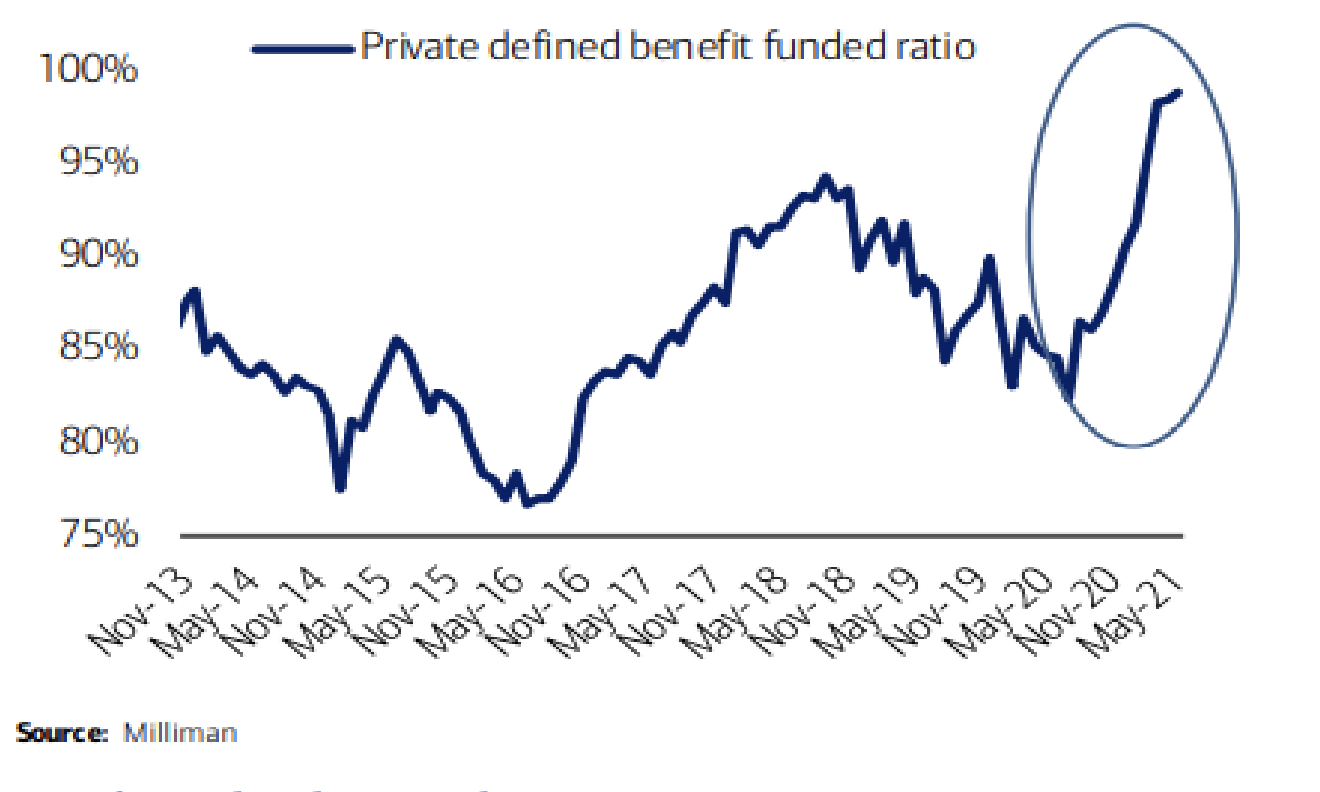
Secure Benefits and Reduce Funding Costs
There are basically only two ways to secure pension benefits: insurance annuities and defeasement (through cash flow matching benefit payments). Ryan ALM has been a pension watchdog and written many articles on the benefits of cash flow matching. Insurance buyout annuities (IBA) are expensive, but corporations are purchasing IBAs in record amounts to get rid of the high and rising PBGC premiums caused by the MAP 21 legislation of July 6, 2012 and to avoid longevity risk. However, corporations would be wise to do a cost analysis of the IBA versus a cash flow matching defeasance. The typical IBA prices Retired Lives (liabilities) at a discount rate of ASC 715 (AA corporate zero-coupon yield curve) plus a 3% to 4% premium. According to our calculations, a defeasance strategy (cash flow matching) using investment grade corporates would provide a cost savings of about 30% versus IBA, which is a very significant cost savings and should be reviewed. Such cost savings are immediate while the IBA savings of eliminating PBGC premiums is in the future.
Cash flow matching (using the Ryan ALM Liability Beta Portfolio™) is a cost optimization process where we go through numerous iterations to find the optimal cost savings that will fund each and every monthly Retired Lives benefit payment. Since liabilities are priced like bonds (ASC 715 discount rates) they behave like bonds. As a result, bonds become the proper assets to match and fund liabilities. Bond math tells us that the longer the maturity and the higher the yield… the lower the cost. Our LBP model skews the portfolio weights to longer maturities such that a 30-year coupon bond will partially fund 29 years of benefits through interest income. The same is true for a 29-year, 28-year, 27-year bond, etc. plus principal cash flow at maturities adds even more cash flow. Cash flow matching reduces funding risk because the bond cash flows are certain and the bonds may be held to maturity. Moreover, cash flow matching is the matching and funding of future values which do not change with changes in interest rates.
Reduce and Stabilize Contribution Costs
The LBP will match each and every monthly benefit payment in the liability schedule it is funding (Retired Lives). This will greatly reduce funded status volatility which will help stabilize contribution costs. The LBP is comprised of investment grade bonds skewed to longer maturities and A/BBB credits, so it will out yield liabilities priced as AA corporates (ASC 715 discount rates) by 50 – 100+ bps. Importantly, this extra yield creates an excess return (Alpha), which enhances the funded status, reduces contribution costs and could reduce the PBGC variable premium.
Only cash flow matching (defeasance) can secure benefits and reduce funding costs with certainty! By matching liabilities (benefit payments) it reduces risk accordingly.
Our LBP has numerous benefits that best achieve the true pension objective:
Cash flow matching the liability benefit payment schedule (Retired Lives) at the lowest cost is the ideal way to manage assets for a pension plan. Since Retired Lives are the most certain and most important (most tenured employees) liabilities, cash flow matching is a perfect fit given the certainty of the bond cash flows. Since the pension objective is a cost focus, cash flow matching would produce the optimal cost savings. We urge corporations to do a cost analysis before they buy an IBA! Even if an IBA is the future goal then the LBP would provide the perfect pension risk transfer of assets to an IBA.
Problem: Immunization (Duration Matching)
Duration matching is a strategy that attempts to reduce financial statement volatility while cash flow matching is a strategy for reducing funding volatility. Another difference is that duration is an ever-changing number so with duration matching the manager must continually rebalance for duration drift, while cash flow matching has the advantage that bond cash flows do not change. When we use duration matching to hedge financial statement volatility, we make assumptions that the yield levels of the liability hedging vehicle will move in parallel with liability yields. The fact is yields for different credits, and maturities do not all move in parallel. To facilitate benefits funding management ALM should focus on the liability yield curve or term structure which is exactly what the Ryan ALM custom liabilities cash flow matching and $ duration matching portfolios do in the most cost-efficient manner.
Traditional duration matching has definite liability cash flow mismatches and cost inefficiencies. Since the longest duration coupon bonds are around 19-years today, duration matching is forced to use Treasury zero-coupon bonds (STRIPS) to fund any liability past 19-years. Since Treasuries are the lowest yielding bonds, they are the highest cost bonds to fund and match liabilities. Moreover, duration is a present value (PV) calculation that is very interest rate sensitive. Duration matching is focused on matching liability % growth rates and not on matching and funding benefit payments (future values) and dollar growth rates.
Solution: Dollar Duration Matching (DDM)
DDM matches the dollar value change per basis point change in yield for assets with the dollar value change per basis point change in yield for liabilities. When the dollar duration of assets is matched to the dollar duration of liabilities for every year in the term structure of liabilities, then DDM is in its most precise form. That would be the equivalent of 30 Key Rate durations… one at every point along the liabilities yield cure or benefit payment schedule. The Ryan ALM DDM approach offers several value-added differences:
Actuarial Projections - We use the actuarial projected benefits of our clients and not a generic bond index benchmark.
Modified durations - to be an effective price sensitivity measurement, duration must be modified. Modified Duration measures the percent change in market value or present value for future value cash flows given a 100-basis point movement in yield.
The Ryan ALM DDM approach greatly improves the accuracy of Key Rate duration matching by matching the dollar value changes in liabilities with the dollar value changes in assets across the term structure and yield curve for liabilities. The liabilities are measured and monitored by using a Custom Liability Index (CLI) to more precisely calculate the dollar value (PV) movement in assets versus liabilities given any movement in interest rates.