

Ryan ALM
White Papers
Pension Alert: Secure Funded Status!
Private Pension Alert: Secure Funded Status! The pension objective is to secure benefits in a cost-efficient manner! Many private pension plans are in the best funded status since 1999. It...
Source: Pension Alert: Secure Funded Status!
Private Pension Alert: Secure Funded Status!
The pension objective is to secure benefits in a cost-efficient manner!
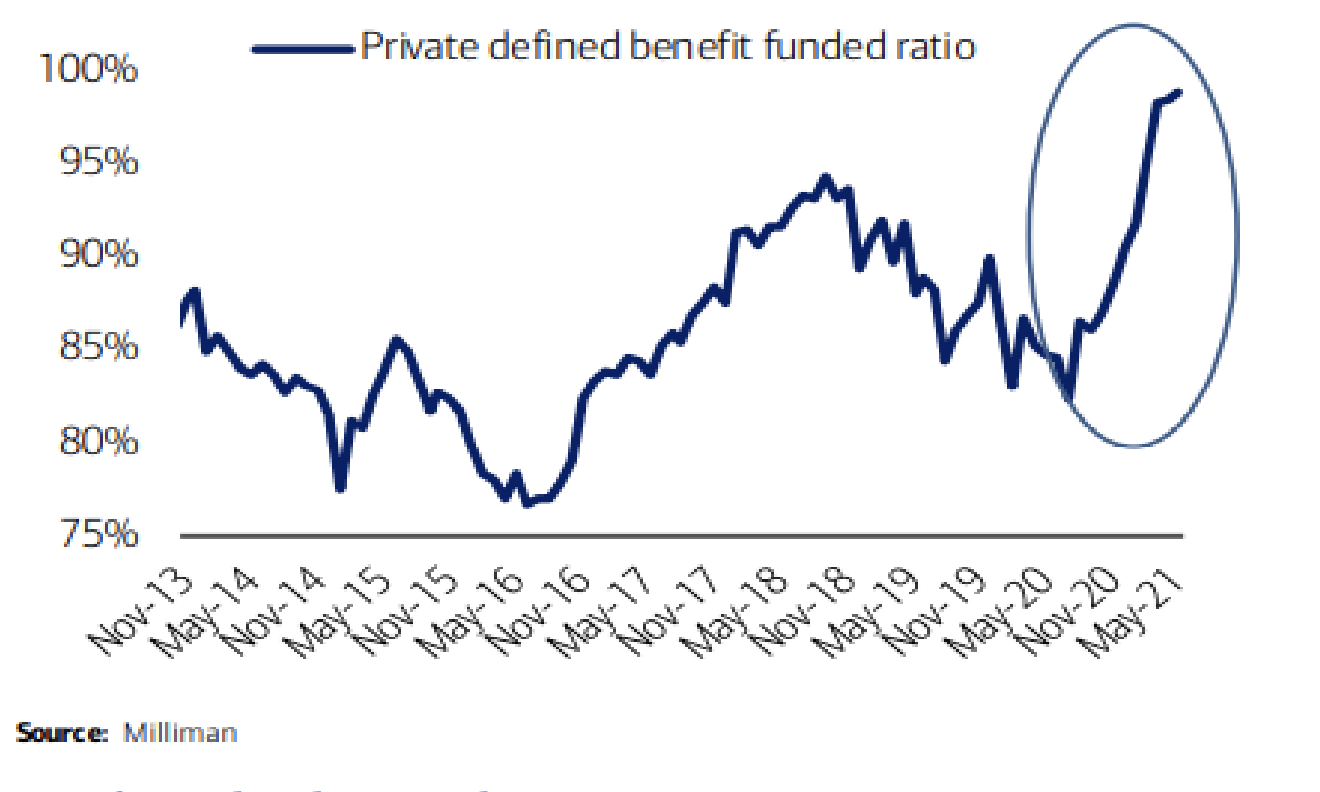
Many private pension plans are in the best funded status since 1999. It should be a high priority to secure this funded status NOW if not enhance it.
Secure Benefits and Reduce Funding Costs
There are basically only two ways to secure pension benefits: insurance annuities and defeasement (through cash flow matching benefit payments). Ryan ALM has been a pension watchdog and written many articles on the benefits of cash flow matching. Insurance buyout annuities (IBA) are expensive, but corporations are purchasing IBAs in record amounts to get rid of the high and rising PBGC premiums caused by the MAP 21 legislation of July 6, 2012 and to avoid longevity risk. However, corporations would be wise to do a cost analysis of the IBA versus a cash flow matching defeasance. The typical IBA prices Retired Lives (liabilities) at a discount rate of ASC 715 (AA corporate zero-coupon yield curve) plus a 3% to 4% premium. According to our calculations, a defeasance strategy (cash flow matching) using investment grade corporates would provide a cost savings of about 30% versus IBA, which is a very significant cost savings and should be reviewed. Such cost savings are immediate while the IBA savings of eliminating PBGC premiums is in the future.
Cash flow matching (using the Ryan ALM Liability Beta Portfolio™) is a cost optimization process where we go through numerous iterations to find the optimal cost savings that will fund each and every monthly Retired Lives benefit payment. Since liabilities are priced like bonds (ASC 715 discount rates) they behave like bonds. As a result, bonds become the proper assets to match and fund liabilities. Bond math tells us that the longer the maturity and the higher the yield… the lower the cost. Our LBP model skews the portfolio weights to longer maturities such that a 30-year coupon bond will partially fund 29 years of benefits through interest income. The same is true for a 29-year, 28-year, 27-year bond, etc. plus principal cash flow at maturities adds even more cash flow. Cash flow matching reduces funding risk because the bond cash flows are certain and the bonds may be held to maturity. Moreover, cash flow matching is the matching and funding of future values which do not change with changes in interest rates.
Reduce and Stabilize Contribution Costs
The LBP will match each and every monthly benefit payment in the liability schedule it is funding (Retired Lives). This will greatly reduce funded status volatility which will help stabilize contribution costs. The LBP is comprised of investment grade bonds skewed to longer maturities and A/BBB credits, so it will out yield liabilities priced as AA corporates (ASC 715 discount rates) by 50 – 100+ bps. Importantly, this extra yield creates an excess return (Alpha), which enhances the funded status, reduces contribution costs and could reduce the PBGC variable premium.
Only cash flow matching (defeasance) can secure benefits and reduce funding costs with certainty! By matching liabilities (benefit payments) it reduces risk accordingly.
Our LBP has numerous benefits that best achieve the true pension objective:
Cash flow matching the liability benefit payment schedule (Retired Lives) at the lowest cost is the ideal way to manage assets for a pension plan. Since Retired Lives are the most certain and most important (most tenured employees) liabilities, cash flow matching is a perfect fit given the certainty of the bond cash flows. Since the pension objective is a cost focus, cash flow matching would produce the optimal cost savings. We urge corporations to do a cost analysis before they buy an IBA! Even if an IBA is the future goal then the LBP would provide the perfect pension risk transfer of assets to an IBA.
Problem: Immunization (Duration Matching)
Duration matching is a strategy that attempts to reduce financial statement volatility while cash flow matching is a strategy for reducing funding volatility. Another difference is that duration is an ever-changing number so with duration matching the manager must continually rebalance for duration drift, while cash flow matching has the advantage that bond cash flows do not change. When we use duration matching to hedge financial statement volatility, we make assumptions that the yield levels of the liability hedging vehicle will move in parallel with liability yields. The fact is yields for different credits, and maturities do not all move in parallel. To facilitate benefits funding management ALM should focus on the liability yield curve or term structure which is exactly what the Ryan ALM custom liabilities cash flow matching and $ duration matching portfolios do in the most cost-efficient manner.
Traditional duration matching has definite liability cash flow mismatches and cost inefficiencies. Since the longest duration coupon bonds are around 19-years today, duration matching is forced to use Treasury zero-coupon bonds (STRIPS) to fund any liability past 19-years. Since Treasuries are the lowest yielding bonds, they are the highest cost bonds to fund and match liabilities. Moreover, duration is a present value (PV) calculation that is very interest rate sensitive. Duration matching is focused on matching liability % growth rates and not on matching and funding benefit payments (future values) and dollar growth rates.
Solution: Dollar Duration Matching (DDM)
DDM matches the dollar value change per basis point change in yield for assets with the dollar value change per basis point change in yield for liabilities. When the dollar duration of assets is matched to the dollar duration of liabilities for every year in the term structure of liabilities, then DDM is in its most precise form. That would be the equivalent of 30 Key Rate durations… one at every point along the liabilities yield cure or benefit payment schedule. The Ryan ALM DDM approach offers several value-added differences:
Actuarial Projections - We use the actuarial projected benefits of our clients and not a generic bond index benchmark.
Modified durations - to be an effective price sensitivity measurement, duration must be modified. Modified Duration measures the percent change in market value or present value for future value cash flows given a 100-basis point movement in yield.
The Ryan ALM DDM approach greatly improves the accuracy of Key Rate duration matching by matching the dollar value changes in liabilities with the dollar value changes in assets across the term structure and yield curve for liabilities. The liabilities are measured and monitored by using a Custom Liability Index (CLI) to more precisely calculate the dollar value (PV) movement in assets versus liabilities given any movement in interest rates.
Best way to hedge pension inflation
Ronald J. Ryan, CFA, CEO July 2020 Executive Summary Pension inflation is what a plan sponsor agrees to as a cost of living adjustment (COLAs) benefit increase for retired lives...
Source: Best way to hedge pension inflation
Executive Summary
Pension inflation is what a plan sponsor agrees to as a cost of living adjustment (COLAs) benefit increase for retired lives and a salary increase factor for active lives. Quite often, these COLAS are based on the CPI with a floor and a cap or even a % of the CPI while salary increases tend to be quite static @ a 3% annual increase. As a result, pension inflation tends to be less volatile and certainly different than the CPI. Please note that the plan will mismatch the actuarial pension inflation and may introduce
Best way to hedge pension inflation
Many pensions have an allocation to some type of inflation hedge strategy. The most common asset strategies are TIPS and real assets. These strategies are based on hedging or outperforming the CPI. The truth is… these are not appropriate strategies for hedging pension inflation. Pension inflation is what a plan sponsor agrees to as a cost of living adjustment (COLAs) benefit increase for retired lives and a salary increase factor for active lives. Quite often, these COLAS are based on the CPI with a floor and a cap or even a % of the CPI while salary increases tend to be quite static at a 3% annual increase. As a result, pension inflation tends to be less volatile and certainly different than the CPI. Please note that the plan sponsor actuary includes pension inflation (COLAs and salary increases) in their projected benefit payment schedule for both retired and active lives. As a result, the best and, perhaps only way, to hedge pension inflation is to… cash flow match projected benefits! All other inflation strategies (i.e. TIPS and real assets) will mismatch the actuarial pension inflation and may introduce higher cost and fees.
Solution: Cash Flow Match Liabilities
Securing benefits of Retired Lives by matching and funding the projected liability benefit payment schedule (liability cash flows) at the lowest cost is the highest priority of any pension. This is also the ideal way to de-risk a pension plan and hedge pension inflation. Since the actuary includes pension inflation in their liability projections, by cash flow matching the projected liability cash flows (benefit payments) you have hedged pension inflation accurately. There is no other asset strategy that can hedge actuarial pension inflation exactly except insurance annuities which come at a high cost (25% to 40% higher than cash flow matching liability cash flows).
Ryan ALM built a liability cash flow matching product, named the Liability Beta Portfolio™ (LBP), as a cost optimization model that matches and funds the actuarial projected liability benefit payment schedule for retired lives at the lowest cost given the investment policy restrictions of our clients. The LBP portfolio is composed of investment grade corporate bonds skewed to A and BBB corporate bonds since that represents about 89% of the investable investment grade corporate bond universe. Our LBP also accepts and uses high yield bonds if the client investment policy allows.
The LBP provides a 10% to 20% funding cost savings versus the projected benefit payments of retired lives (liability cash flows) and a 20% to 30% cost savings versus using Treasury STRIPS to defease the same liabilities (STRIPS is the discount rate method used by insurance annuities)! This is a serious cost reduction and should be a major consideration of any defined benefit pension plan asset allocation, inflation hedge or de-risking strategy. Yes, the LBP model has some credit risk but very limited since we are using investment grade bonds with several credit filters (to enhance solvency) plus the cost savings provide a large value-added cushion.
We recommend funding the first 10 years of Retired Lives on a net liability basis (after contributions). In truth, current assets fund the net liabilities not the gross liabilities as contributions are the initial funding source of liabilities. Our LBP model will calculate with precision the cost to fund net liabilities chronologically in a cost-effective manner which will de-risk the plan gradually. Since liabilities are funded initially by contributions, using the LBP model to cash flow match net liabilities chronologically may be able to fund more liabilities than you think. Contributions tend to be quite large (especially with many Public plans where actuarially determined contributions are legislated) such that a 10% allocation to our LBP could often fund the next 10-years of net Retired Lives easily.
Matching liabilities chronologically should also buy time for the non-bond assets (Alpha assets) to perform and outgrow liabilities. Given time (10 years) most non-bond asset classes tend to outperform bonds. Since pension liabilities behave like bonds there is a high probability that non-bond asset classes should outperform liability growth over an extended time horizon, especially at today’s low yield on bonds (and liabilities) which would enhance the funded status.
Since the primary pension liability objective is to secure benefits in a cost-effective manner, cash flow matching net liabilities with our Liability Beta Portfolio™ would secure benefits and produce the optimalcost savings.
Asset Allocation (AA)
Pension consultants and plan sponsors should consider installing our LBP as the core portfolio in asset allocation. The best value in bonds is the certainty of their cash flows. Bonds are usually not considered performance assets (Alpha assets) especially versus pension liabilities which behave like bonds. By installing the LBP to fund the first 10 years of net Retired Lives, the pension plan buys time for the Alpha assets (non-bonds) to perform. As the Alpha assets perform versus liability growth, thereby enhancing the funded ratio, such excess returns could be transferred (ported) over to the Liability Beta Portfolio™ (LBP) to de-risk more and more liabilities thereby creating a … Portable Alpha strategy. Had this Portable Alpha discipline been in place during the decade of the 1990s when funded ratios grew to their highest historical levels with true economic surpluses… there would be no U.S. pension crisis today!
Note – The largest U.S. DB pension (CalPERS) removed their 9% asset allocation to inflation hedge assets in 2019.
About Ryan ALM, Inc.
Ryan ALM was founded by Ronald J. Ryan, CFA on July 12, 2004 as an Asset/Liability Management firm. The firm builds a turnkey system of proprietary synergistic products designed to measure liabilities as a Custom Liability Index (CLI) and manage assets to the CLI as Liability Beta Portfolios.
Ryan ALM is unique in having its own proprietary Index company named ALM Research Solutions, LLC. This company builds both custom and generic bond indexes. Such indexes range from Custom Liability Indexes to ETF Indexes.
Our Liability Beta Portfolio™ is our proprietary cost optimization model that "cash flow matches" clients projected liability benefit payment schedules at the least cost using investment grade bonds. It is back-tested since 2009 showing a consistent cost savings of 8% to 15%. Our LBP best represents the core portfolio of a pension plan.
Our team has been recognized for our expertise and results including Ron Ryan having won the William F. Sharpe Index Lifetime Achievement Award.