

Ryan ALM
Blog
Everything is on the line!
It has been reported that two more multiemployer pension systems - Arizona Bricklayers and the Michigan Carpenters - have filed for benefit relief under the Multiemployer Pension Reform Act of 2014 (MPRA). This is the second application for the Carpenters...
It has been reported that two more multiemployer pension systems - Arizona Bricklayers and the Michigan Carpenters - have filed for benefit relief under the Multiemployer Pension Reform Act of 2014 (MPRA). This is the second application for the Carpenters after they withdrew their first proposal earlier this year. Although the actual cuts to benefits may be different, the factors creating the deterioration in funding are similar in that the number of active employees fell dramatically in relationship to the number of retired participants, the number of employers contributing to the plan also fell, while the number of hours worked (determines contributions) were impacted by multiple economic shocks and have yet to recover.
In the case of the Arizona Bricklayers' plan, ALL the accrued benefits will be recalculated to a maximum of 110% of the PBGC's guaranteed amount. As a reminder, the PBGC's guaranteed amount for a 30-year employee at age 65 is ONLY $12,870. It can be quite smaller for those that didn't achieve a 30-year career. For comparison purposes, the PBGC's private insurance program protects benefits to >$72,000 for equally tenured employees. For the Carpenters, their benefits will be slashed by 32% under MPRA! How many of you could withstand a cut in compensation of this magnitude without having it jeopardize your financial future?
It really pains me to think that our government is sanctioning this action. MPRA has little to do with pension reform and everything to do with slashing benefits, while financially burdening workers who had very little to do with the problems related to their plans. Regrettably, Congress continues to dawdle as it relates to true pension reform and as they wait the crisis magnifies. Unfortunately, we have roughly 1.4 million American workers tethered to pension plans that have been designated as in Critical and Declining shape. The only potential resolution to this situation is through legislation. There is no "earning" one's way out of this jam.
The Butch Lewis Act (BLA), which currently resides in the Senate after having been passed by the House, is wonderful legislation that actually reforms pensions, unlike MPRA, while simultaneously protecting the promised benefits. For those plans that have filed for and been granted relief under MPRA, the benefits that have been slashed would be reinstated under the BLA should they file for a loan. Let's hope that there is finally a sense of urgency within Congress that will lead all parties to conclude that the BLA is the right path forward and the time is now!
This Makes NO Sense
Corporate America has been exiting from defined benefit plans for decades. There are many reasons why this trend exists, but one of the primary reasons cited often focuses on the excessive cost to insure these plans/participants with the PBGC. As...
Corporate America has been exiting from defined benefit plans for decades. There are many reasons why this trend exists, but one of the primary reasons cited often focuses on the excessive cost to insure these plans/participants with the PBGC. As a reminder, there are two annual PBGC costs associated with single-employer plans, including both fixed and variable costs. In 2019, the PBGC charged $80 per participant as a fixed cost, and an additional variable premium charge of $43/$1,000 of UVB (unfunded vested benefit) with a maximum cost of $541/participant. As you can imagine, those costs add up quickly.
Multiemployer plans are also insured by the PBGC, but they participate in a separate pool from single-employer plans. As of 2019, Multiemployer plans were charged $29/participant with no additional variable payment. As a result, the level of participant protection is vastly different with the benefits of participants in single-employer plans protected to more than $72,000/year, while a 30-year veteran aged 65 under a multiemployer pension plan would receive a maximum benefit of only $12,870 or about 1/5 of an employee who worked the same length of time, but was fortunate to work for a private company.
With that information as a backdrop, how does it make sense that a proposal being floated in DC to "help" multiemployer plans calls for drastically raising the premium per participant to the same level currently charged single-employer plans? If high premiums are one reason cited for the demise of DB plans within corporate America, how are struggling multiemployer plans going to afford this ridiculous increase? Furthermore, this "rescue plan" contemplates a tax on both active participants as well as current retirees? Wasn't this a benefit that was promised to, and in many cases, paid partially by the employee?
Levying these additional costs on top of struggling plans that in many cases have few years of solvency left is nothing more than an attempt to drive these plans into bankruptcy and ultimately the PBGC, as opposed to actually providing a lifeline to protecting and preserving theses critically important programs. The other proposal being considered is the Butch Lewis Act, which was passed by the House of Representatives in July 2019. This legislation calls for low-interest rate loans from the U.S. Treasury Department based on the 30-year Treasury rate to be offered to the plans that are designated as in critical and declining status. Given the historically low Treasury 30-year rates today, the timing could hardly be better. It is estimated that the net cost of this proposal is $31.8 billion. However, when Cheiron (pension actuaries) did the original work, 111 of the 114 plans reviewed at that time were able to pay back the loans at the end of 30-years. Given that fact, where is the cost to the taxpayer? It certainly isn't $31.8 billion.
But, even if it were to be a cost of $31.8 billion, why shouldn’t the stimulus package include multiemployer pensions whose assets were hard hit by the Covid-19 pandemic? With the Federal government handing out trillions to support every conceivable program, why not pensions? The 1.4 million American workers in these failing plans need our support. Furthermore, the economic activity produced by these benefit payments far outpaces the estimated cost to support them. Let's not be penny wise, but pound foolish. Let's put forth legislation that actually protects and preserves these plans as opposed to driving them into the PBGC where participants are likely to receive only pennies on their promised dollar of benefits.
Waiting for Godot?
Come on already! The multiemployer retirement crisis continues to worsen daily. When will we finally see action? Time for more review has long passed. Further delays are unacceptable. There certainly has been a lot of talk related to this evolving...
Come on already! The multiemployer retirement crisis continues to worsen daily. When will we finally see action? Time for more review has long passed. Further delays are unacceptable.
There certainly has been a lot of talk related to this evolving crisis for years and years. It finally looked as if a resolution would be achieved when the Butch Lewis Act (BLA) was passed by the House of Representatives in July 2019 with some bipartisan support. However, that Bill has gone nowhere within the Senate. Lately, it appeared that stimulus discussions were about to provide a glimmer of hope, but regrettably nothing was accomplished when negotiations were stopped until after the election.
Now, we get a Memorandum (10/22/20) from President Trump related to the Delphi salaries and non-unionized employees pension plan that he is authorizing "the Secretary of the Treasury, the Secretary of Commerce, and the Secretary of Labor, in consultation with the Assistant to the President for Trade and Manufacturing Policy to review the Delphi matter described in subsection 1(a) of this memorandum and inform the President within 90 days of the date of this memorandum of any appropriate action that may be taken". This memorandum reads well, as it states that "it is the policy of the United States to support America’s workers, regardless of union affiliation, to protect the pensions of hardworking Americans". But inaction, such as we've seen for years, does nothing to support hard working Americans!
Furthermore, it reads that "reforms are needed to maintain the solvency of these critical programs (PBGC's single and multiemployer insurance programs) into the future, so that those Americans with pensions under the PBGC’s trusteeship have financial certainty and security. NO! Why wait until these plans collapse? There is a better way… the BLA. The BLA specifically protects and preserves these plans BEFORE they end up with the PBGC. No American worker wants to see their pension fail, especially if it means that they will be subject to a maximum benefit threshold that is dramatically lower than their promised benefit.
The proposed stimulus bill (roughly $2 TRILLION) did NOT include any money for the protection of multiemployer pension systems. Why not? Most pensions were hurt by the Covid-19 as pension assets had negative returns during this covid-19 period thereby affecting their funded status solvency. It seems like a no-brainer that both parties would want to secure the pensions for 1.4 million Americans who were promised a benefit that now may be taken away from them through draconian cuts. You would think that both parties would want to do everything possible to entice this pension cohort into voting for the party that has done the most to protect their retirements. Yet, that hasn't happened.
If you haven't reviewed the stimulus proposal, and I can't blame you if you haven't, you will be amazed with what was included that carried more urgency than the "protection of the pensions of hardworking Americans". The original cost of the BLA legislation was roughly $34 billion over 10-years. That would represent only 1.5% of the total stimulus, but it still didn't get included. Yet, there was money for NPR, museums and libraries, $20 billion for the USPS, salary increases for House of Representative members (!!!), $600 million for the endowments of the Arts and Humanities, the Agency of International Development and another $300 million for International Disaster Assistance, and $100 million to NASA. There are 100s, if not 1,000s, of allocations to various causes and Congressional pet projects, but NOTHING for the "Hard Working American" whose pension is about to get trashed!
The retirement crisis "can" has been kicked down the street for way to long. There is little left of that can and certainly no more time to be wasted. Let's allocate our precious financial resources where they are most needed and not to various pet projects. The financial future for millions of American workers are in the balance.
The Frustration is Palpable and More Than Justified!
Participants in failing multiemployer pension plans have fought for years to have their benefits restored and pension reform legislation passed, and to this point those incredible efforts have mostly fallen on deaf ears. They have been close at times to...
Participants in failing multiemployer pension plans have fought for years to have their benefits restored and pension reform legislation passed, and to this point those incredible efforts have mostly fallen on deaf ears. They have been close at times to getting the relief that they need, such as the Butch Lewis Act being passed by the House of Representatives in 2019, only to have the US Senate fail to act on it. They were recently encouraging that negotiations surrounding another stimulus package would include the necessary funds to FINALLY get pension reform passed.
Regrettably, those efforts were once again met with empty promises by our "leaders" in Washington DC. In fact, the Senate has turned its collective back once more by recessing until November 9th, thus eliminating any possible last-ditch effort to provide necessary economic support to struggling American workers and pensioners prior to the election. Instead of getting legislation passed that would protect and preserve the promised benefits, we have only gotten legislation (MPRA) that allows struggling pension systems to break their promise to their workers by CUTTING benefits, and in many cases, those cuts amount to more than 50%. To date, 18 plans covering more than 100,000 plan participants have been permitted by the DOL to slash those promises - shameful!
Unfortunately, there are roughly 130 other Critical and Declining multiemployer plans that are on the cusp of failure and another 200+ that are deemed to be in Critical status. There are approximately 1.4 million Americans in the C&D plans that could see their retirements dramatically altered. These folks did nothing wrong, and to penalize them is just not right. It would be one thing if the PBGC's multiemployer insurance pool actually had the financial resources to protect the promised benefits, but this entity's financial condition is atrocious.
The PBGC has recently published the maximum benefits for 2021 for a 30-year employee at age 65-years-old, and it is once again $12,870. This is 5.6 times lower than the maximum benefit for a similarly tenured employee in a private single employer plan, which stands at $72,409 for next year. This massive difference continues to grow each year as the single-employer pension benefits are indexed, while the multiemployer protection is negotiated, and that level of protection hasn't changed in years.
It would be one thing if the annual premiums per participant were 6 times greater for a single employer fund versus a multiemployer fund, but that is just not the case. According to the PBGC's website, the 2021 premiums are $31 per participant in a multiemployer plan and $86 per participant in a single-employer plan. At the very least, participants in multiemployer plans should have their benefits protected to 36% of the maximum single-employer pension or $26,100. But, why stop there? Does it make sense to protect one class of beneficiary at nearly 6 times that rate of another group?
According to a research report from the Congressional Research Service, a majority of pension beneficiaries had promised payouts greater than the $12,870 limit. For those plans that aren't currently receiving any support from the PBGC, the average benefit is more than twice the maximum protected benefit. If Congress would just get their act together and raise the maximum protected benefit to 50% of the single-employer protection ($36,000), a significant percentage of retirees would receive the benefit that they were promised.
If you find this situation faced by multiemployer pensions to be as unfair as I do, please reach out to your representatives in DC to get them off the fence. Passing the Butch Lewis Act should be the highest priority for the US Senate, but at the very least a renegotiation of the maximum PBGC benefit for multiemployer pensioners should be completed. The benefits to our economy, in the form of demand for goods/services and tax revenue, from these pensioners getting their full promised benefits far outweighs the cost of government support. Plus, it is the right thing to do!
Real People, Real Implications
I frequently read about issues within our pension industry, and there are many. Sometimes, and I am embarrassed to admit this, I fail to connect the problem that is being discussed with the harm that the issue in question brings...
I frequently read about issues within our pension industry, and there are many. Sometimes, and I am embarrassed to admit this, I fail to connect the problem that is being discussed with the harm that the issue in question brings to the individual(s) being impacted. For those of you who regularly read this blog, you know that I've written quite a bit about the Butch Lewis Act (legislation to help critical and declining multiemployer plans), and plan participants, such as Carol (8/28/18, 1/24/20, etc.), that desperately need to see this legislation passed in order to have their full benefits that were promised to them restored.
Clearly, Carol is not the only one being impacted by the ability of struggling multiemployer plans to "renegotiate" benefit payments to current and future retirees through MPRA (2014 pension "reform"). Below I present another example of a participant (Robert) whose benefits were slashed to the tune of 67.5%! Please think about your personal circumstances and whether or not you could sustain such a hit and not be financially (or mentally) devastated. Here are Robert's words as printed in a recent Op Ed:
"I worked at Yellow Freight/YRC for 27 years driving a forklift in Buffalo, Cincinnati, Indianapolis and in Maybrook, New York. My full pension was $2,600 a month, which I got for a year and a half. For the last 4 1/2 years, I’ve received $845 a month after my Road Carriers Local 707 pension fund went insolvent." "We need the Butch Lewis Act to pass, to help those in multiemployer pension funds like mine." Robert McGonigal, Clearwater, Florida
I am so sorry to read about your specific circumstance, Robert. It is not acceptable to me that our government is permitting plans to renege on the promise that was made to plan participants, who in most cases funded a portion of the benefits through the deferral of hourly raises. As a reminder, there are roughly 1.4 million American workers in these struggling plans that could see dramatic reductions, like those of Carol and Robert, without some form of pension relief. I prefer the Butch Lewis Act, and I think that most multiemployer plans do, too. It is time to get this done. The harm that is being wrought is truly unacceptable.
It Is National Retirement Security Week
National Retirement Security Week, held during the third week in October, is a dedicated effort to raising awareness and helping individuals take concrete steps towards a secure retirement. The week-long observance was initiated in 2006 after U.S. Senators Gordon Smith...
National Retirement Security Week, held during the third week in October, is a dedicated effort to raising awareness and helping individuals take concrete steps towards a secure retirement. The week-long observance was initiated in 2006 after U.S. Senators Gordon Smith (R-OR) and Kent Conrad (D-ND) introduced a resolution for its creation. Beyond elevating public knowledge on the subject, those leading National Retirement Security Week (October 18-24 this year) encourages employees to speak to a retirement plan consultant or expert, and participate in an employer-sponsored retirement plan if available.
At Ryan ALM, we focus our attention on this critical issue 52 weeks per year, believing that everyone should have the opportunity to retire with dignity. As many of you know, our effort is focused on protecting and preserving defined benefit plans as the primary retirement vehicle. We strive to do this through a liability-focused lens. Defined contribution plans are fine as a supplemental savings vehicle, but DB plans provide REAL security. Let us help you preserve your pension plan for your employees and retirees. Together we can make a difference and insure that they will actually get to retire and enjoy it once it is started.
A Disconcerting Trend
I read a stat the other day that got me thinking. The report from which I grabbed my nugget of information indicated that the Millennial cohort has roughly 3% of the total wealth in the US. It seemed like a...
I read a stat the other day that got me thinking. The report from which I grabbed my nugget of information indicated that the Millennial cohort has roughly 3% of the total wealth in the US. It seemed like a small share of the total wealth, but I lacked context. Was this percentage of wealth normal given that Millennials are only just hitting their strides? Unfortunately, for my four older Millennial children (we have a Gen Zer, too) and the millions of others of a similar age, this percentage of wealth is exceptionally (and shockingly) small.
When Boomers were approximately the same age as Millennials are today, they owned nearly 7 times the wealth that Millennials possess. Not 7% more, but 7 TIMES with more than 21% of the total pie. In fact, the Silent Generations' wealth was ONLY two times that of Boomers. Unfortunately for Millennials, their wealth accumulation has basically flat-lined.
No matter which generation we are referring to, wealth creation for those under 40 is a struggle, and Millennials are following this same pattern, and perhaps worse. What is particularly striking for me is how wealth creation has basically fallen off a cliff for those just hitting their 40's (prime earning years?). As the following chart highlights, those aged 40-54 once averaged about 33% to 37% of the wealth at anytime up until about 2003. Today, their share of the pie has collapsed to just over 20%.
Poor wage growth, brought about by two major recessions, has conspired with significantly rising expenditures related to housing, college (student loans), healthcare, childcare, etc. to create the perfect storm. These realities are making it nearly impossible for this cohort to adequately fund their own retirement through a defined contribution plan. The long-term implications will be grave.
This generation has gotten a bad reputation because of their supposed spending habits (latte and avocado toast crowd), but so many things have conspired against them to create the current crisis. As the job market continues to transform, requiring workers to be more flexible responding to on-call/on-demand jobs, Millennials, and those generations that follow, will have a much more difficult time preparing for retirement, as they work to just keep meeting their basic needs.
And Then There were 61!
I wish that my reference to the # 61 had to do with Roger Maris breaking Babe Ruth's home run record, but alas it has to do with the fact that there are ONLY 61 companies in the S&P 500...
I wish that my reference to the # 61 had to do with Roger Maris breaking Babe Ruth's home run record, but alas it has to do with the fact that there are ONLY 61 companies in the S&P 500 with a defined benefit plan still accepting new employees. What was once an important tool for the recruiting and retention of employees, the defined benefit pension is rapidly following the same path once taken by the dinosaur.
There are many reasons why DB plans are fast approaching extinction, but you can lay the primary blame on both legislation and collapsing interest rates. Tax cuts in 1986 and again in 2017 removed much of the incentive to offer this important retirement vehicle. In addition, escalating PBGC premiums are a tremendous financial burden, especially for those plans with funded ratios below 85%. Lastly, Fed policy decisions that have driven US interest rates to nearly 0% have obviously contributed to a dramatic rise in the present value of those future benefit payments.
Who loses? Obviously, the American worker is the loser in this development. As a result of the demise of DB plans, we are left with an inferior scheme in DC plans that forces untrained individuals to fund, manage, and then disburse this "benefit". Many Americans continue to struggle with the fallout from two vicious recessions and the Covid-19 crisis that have produced a tremendous loss of employment opportunities and wealth for a significant portion of our working population.
Call me naive, but I believe that companies trying to recruit the best talent, while also trying to hold onto their most important employees would be best served by offering a defined benefit plan that helps them manage their workforce through time. Are there potential issues? Certainly! Are they insurmountable? Hardly! I am very concerned about the impact of our failing retirement system on our broader economy, especially as our population ages. It is time for the Federal government to take the lead in rethinking many of the issues that have gotten us to this point before it is much too late.
Ryan ALM 3Q'20 Newsletter
We are happy to share with you the Ryan ALM 3Q'20 Newsletter . As is always the case, our newsletter provides a unique perspective on how pension assets have been performing versus plan liabilities and the history of those relationships....
We are happy to share with you the Ryan ALM 3Q'20 Newsletter. As is always the case, our newsletter provides a unique perspective on how pension assets have been performing versus plan liabilities and the history of those relationships. In addition, our newsletter contains links to recent research articles and blog posts. We hope that you find our perspective useful. Finally, we encourage and look forward to your feedback.
The Gap Matters Big time!
At roughly the same time that traditional DB plans were starting to fade from use in the private sector and workers were being asked to primarily fund their own retirements through a DC option, wage growth diverged unexpectedly and significantly...
At roughly the same time that traditional DB plans were starting to fade from use in the private sector and workers were being asked to primarily fund their own retirements through a DC option, wage growth diverged unexpectedly and significantly from productivity growth.
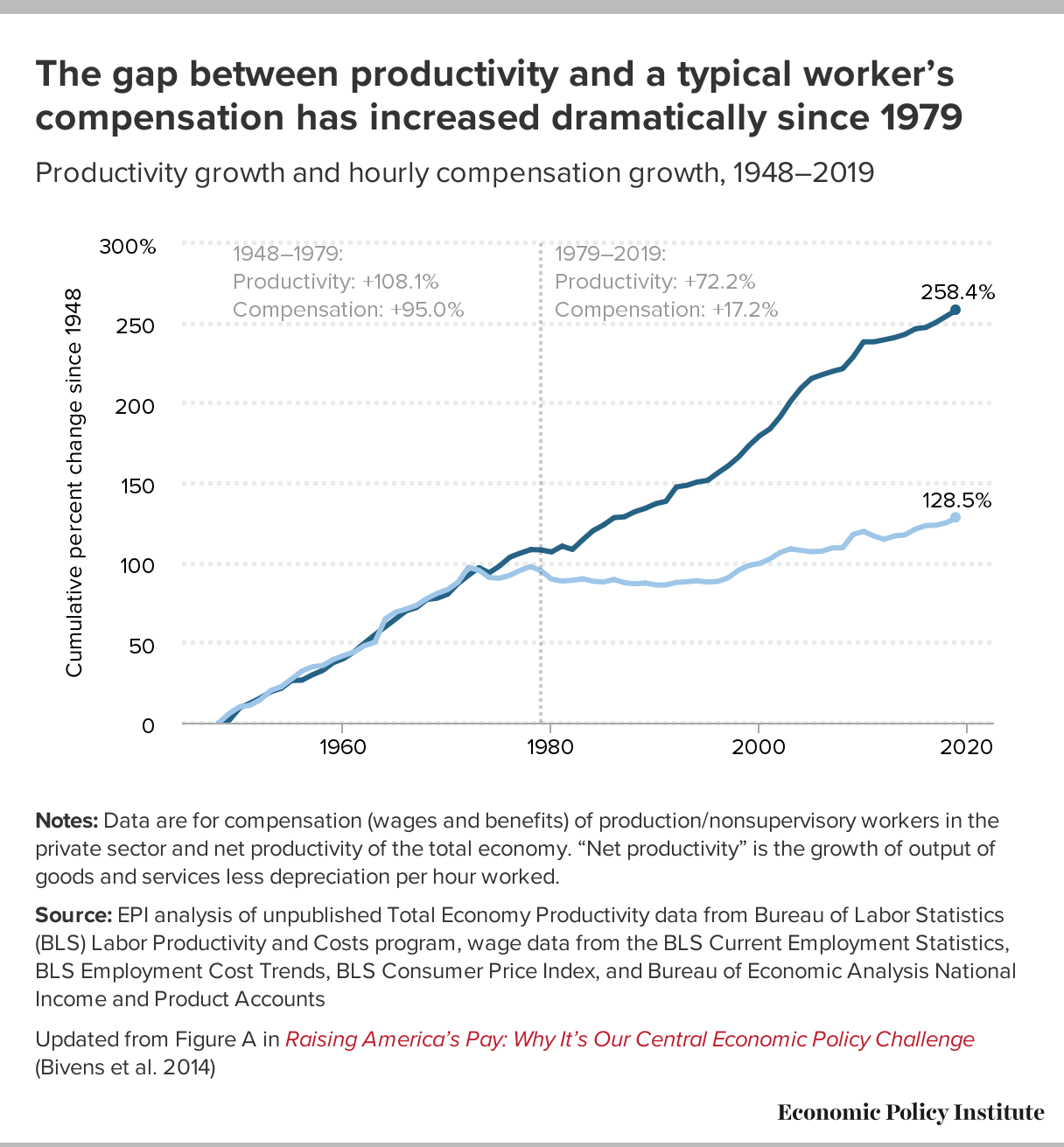
The lack of wage growth not only coincided with the loss of a pension for many Americans, but it also came at the same time of rapidly rising costs for housing, education, healthcare, etc. Should we really be surprised that Americans are falling behind in saving for retirement? I've often stated that there is a basic level of income needed for the average American to live. Regrettably, for many Americans their current wage falls far below that basic level.
The folks at MIT have created a "Living Wage" calculator that helps to determine the necessary minimum wage based on local cost of living expenses. For instance, a single mother with two children living in Newark, NJ needs to earn $42.33/hour to meet her basic living expenses. Unfortunately, the minimum wage currently in NJ is $11.10/hour or roughly 1/4 of what she actually needs. If you are living in Mobile, AL, that single mother of two children requires an hourly compensation of $28.42 or roughly 2/3s what is needed in Newark. Regrettably, the minimum wage in Mobile is $7.25: again, roughly 1/4 of what is needed.
For our Newark resident who works 40 hours per week and 52 weeks per year, the annual compensation that she would need in order to meet her basic living expenses would be $88,046. As of 2018, the median family income in Newark, NJ was a shockingly low $37,642, or roughly 42.8% of what that family of three needs. Is there any wonder why she may not be funding her 401(k), if she even has access to one? It drives me crazy when I read about various generations being excessive consumers. You know, the latte, avocado toast people who would rather consume than spend wisely by investing in their future. I find it hard to believe that mom and her kids are spending much money, if any, on lattes.
We absolutely need to address the ever growing wage disparity that weighs heavily on a significant portion of our population. In a previous blog post I highlighted output from a study that found that the lowest quartile of workers by wages had seen a >30% loss of jobs during the Covid-19 crisis. These individuals have very little in financial resources to weather any loss of a job/wages, let alone continue to fund a retirement benefit. It is critically important to our workers and to our economy that we preserve DB plans for the masses so that older members of our society can remain active participants in our economy demanding goods and services. DC plans should continue to be supplemental to true retirement funds, as they were initially considered. Anything short of this will result in failure.