

Ryan ALM
Blog
The Benefits of Becoming More Liability Aware
For decades, Pension America has focused almost exclusively on cobbling together a portfolio designed to exceed the return on asset assumption (ROA), and for decades many plans have failed. As a result, the ROA objective continues to fall. As we...
For decades, Pension America has focused almost exclusively on cobbling together a portfolio designed to exceed the return on asset assumption (ROA), and for decades many plans have failed. As a result, the ROA objective continues to fall. As we discussed yesterday, in 2010 the median ROA target for public pensions was 8% and today it has fallen to 7.25%. During that period assets have continued to underperform liability growth insuring that plan funded status would decline despite the tremendous equity bull market, while contribution expenses have grown exponentially. Is there another approach that should be explored? Absolutely!The objective of a pension system is to SECURE the promised benefits in a cost-efficient manner. Unfortunately, there are only two ways to secure benefits: 1) Insurance annuity buyouts, and 2) Cash flow matching liabilities through a bond portfolio. Many believe that duration matching strategies accomplish this objective but they don't as they don't have certain cash flows to meet the future benefit payments.Importantly, getting ones arms around the promised benefits (plan liabilities) is the only way that a DB plan can de-risk. Through becoming more liability aware a plan sponsor can acquire the following:
- Greater transparency of the plan’s unique liabilities in multiple dimensions - discount rates based on GASB (ROA), FASB and a risk-free rate (STRIPS)
- Enhanced knowledge of both cash flow and liquidity requirements
- Greater accuracy in calculating the TRUE return on assets (ROA) that is required in a test of solvency
- The ability to establish a cash flow matching bond portfolio created to meet benefit payments
- Stabilization of both the funded status and contribution expense
- A much longer investing horizon for the portfolio’s growth assets in order to fund future liabilities
- Reduced costs
- Peace of mind that benefits are secure for the next 10 years or so (depends on funded status)
- Enhanced viability of the pension system
These benefits seem to be pretty significant, yet many plans fail to gain these advantages. Regrettably, most plans only get a once-per-year view of their specific liabilities, which is too infrequent to engage in these important activities. There are many reasons why we've witnessed a dramatic reduction in the use of defined benefit plans. Becoming liablity aware will help secure those that remain. Our participants are counting on our industry to take a different path to help them achieve a prosperous retirement.
Going to FPPTA Next Week?
The Florida Public Pension Trustees Association (FPPTA) will be hosting their next Trustee School event from October 6-9 at the Sawgrass Marriott. My partner, Ron Ryan, will be speaking once again to the trustees and others that will be in...
The Florida Public Pension Trustees Association (FPPTA) will be hosting their next Trustee School event from October 6-9 at the Sawgrass Marriott. My partner, Ron Ryan, will be speaking once again to the trustees and others that will be in attendance. His session:
A Move in the Right Direction
Unlike the "Jeffersons" who were moving on up, public pension systems return on asset assumptions (ROA) are moving on down! Since 2010, 90% of the 129 public pension plans monitored by the National Association of State Retirement Administrators (NASRA) have...
Unlike the "Jeffersons" who were moving on up, public pension systems return on asset assumptions (ROA) are moving on down! Since 2010, 90% of the 129 public pension plans monitored by the National Association of State Retirement Administrators (NASRA) have reduced their annual ROA target. The median objective is now 7.25%, which is down 25 basis points since 2015 and nearly 0.75% since 2010 as reported in a P&I article.This is a move that is overdue and should be applauded as a step in the right direction, as the lower annual objective will mean that public entities have to contribute more each year to make up for the lower return target. The lower ROA objective should also lead to more conservative asset allocations and investment structures since an 8% objective would naturally lead sponsors and their consultants to invest more heavily in equity and alternative investments.Given that we are now 10+ years into a bull market recovery for equities and a roughly 35+ year bull market for bonds, the probability of generating an 8% annualized return during the next decade has likely been diminished. Let us hope that the ability to move forward with a more conservative asset allocation will help plans weather potential market turmoil should a weakening global growth environment lead to a recession in the U.S. at some point.Now, if one wanted to help insulate the portfolio from this potential development, one could always cash flow match the plan's Retired Lives chronologically from the nearest benefit payment on out (possibly 1-10 years), which will provide the fund with an extended investing horizon for those assets in the portfolio that benefit from the passage of time. This strategy would also help to improve the plan's liquidity needs, reduce interest rate volatility while stabilizing the funded status and contribution expenses. Intrigued? Please don't hesitate to reach out to us to learn more.
It's The Objective That Defines the Asset Allocation
I had the great pleasure of attending (and speaking at) Opal's Emerging Manager conference in NYC for the last couple of days. I always come away having learned much more than I knew before the day started. However, in the...
I had the great pleasure of attending (and speaking at) Opal's Emerging Manager conference in NYC for the last couple of days. I always come away having learned much more than I knew before the day started. However, in the last panel of the conference, the moderator, an influential plan sponsor, who I know and really like, asked the members of his panel why pension plans were later to the game investing in hedge funds than E&Fs and HNW individuals. The panel highlighted a number of potential reasons, but I think that the question was phrased inappropriately.I would have asked the question are hedge funds more or less appropriate investments for pension plans than either E&F or HNW individuals? My response would have been that the fund's objective(s) should be what drives asset allocation and individual product exposures. My feeling is that E&F and HNW individuals have annual positive spending policies that dictate more of an absolute return orientation and that pension plans have a relative objective - that being their specific liabilities (benefit promises). Thus, E&Fs have every reason to want and need to produce a consistently positive return, but pension funds need to outperform liability growth, whether that leads to a positive return or not.By focusing on the return on asset assumption and not liability growth, pension systems have severely underperformed liability growth since 12/31/99 by an astounding 170% (according to Ryan ALM). Of course, this period coincided with two major market declines, but the negative impact of these bear markets would have been mitigated had assets and liabilities been more in lock-step with one another. Focusing exclusively on the ROA has injected significantly more volatility into the asset allocations for pension plans than how they were managed decades ago. I'm afraid that the singular focus on the return objective is setting these plans up for significant underperformance and rapidly escalating contribution costs should we encounter another bear market in the not-too-distant-future.Investing in hedge funds won't protect the asset side of the equation from underperforming plan liabilities in such an environment. They might help E&Fs and INW individuals, but then again, they have a very different annual objective.
What Am I Missing?
CIO Magazine has published an article that cites the Congressional Budget Office (CBO) indicating that the proposed pension legislation "The Rehabilitation for Multiemployer Pensions Act of 2019" (H.R. 397) won't be enough to protect and preserve all of the plans....
CIO Magazine has published an article that cites the Congressional Budget Office (CBO) indicating that the proposed pension legislation "The Rehabilitation for Multiemployer Pensions Act of 2019" (H.R. 397) won't be enough to protect and preserve all of the plans. In fact, a CBO "study projected that approximately one-quarter of the pension plans that would be eligible for loans through the bill would become insolvent over the next 30 years and would not fully repay their loans. For those plans that do repay their loans, the CBO projects that they will become insolvent within ten years of repayment." What's the issue?At present, there are roughly 125 multiemployer pension plans that are defined as critical and declining. With no action, all of these plans are expected to become insolvent within the next 15 years. By providing loans to these struggling plans, we are extending the payment of benefits by 30+ years. If 25% fail to repay the loan in 30-years, so be it. We've renegotiated terms on a number of government-funded programs, why should this be any different.The CBO estimated that the Pension Rehabilitation Administration (PRA), which would be established to issue the loans, would only have to provide $39.7 billion in funding. Seems like a drop in the bucket when compared to TARP. Furthermore, they estimated that only $7.9 billion would be returned. I'd love to understand the inputs that they used in creating this analysis. When Cheiron, a leading pension actuary, conducted their analysis on the original 114 plans, only 3 - the Central States, Coal Miners, and the Bakery, Confectionery, Tobacco Workers - would need extra support from the PBGC. In fact, the remaining 111 plans could meet current benefit payments, interest on the loan, future pension liabilities, and the balloon payment in 30-years while earning only 6.5% on their investments.Given the modest cost of this loan program and the economic benefit of continuing to provide pension payments to nearly 1.3 million American workers, it seems like a no-brainer to me. What is the economic benefit? According to Congressional testimony, the "cost of doing nothing in terms of lost tax revenue and increased social safety net spending is estimated to be between $170.3 billion and $241.3 billion over the 10-year budget window, and between $332 billion and $479 billion over the next 30 years."So, please explain to me why we, as taxpayers, wouldn't want to "invest" $39.7 billion in a loan program that has, in my humble opinion, a high degree of success, when not doing so would potentially result in a "loss" of nearly $500 billion in economic activity in the next 30-years? I would hope that ideology isn't getting in the way of making a rational decision to finally tackle the pension problem that has existed for decades and one that will only get worse with the passage of more time.
Think the Bottom 50% Can Fund A Retirement Account? Think, Again!
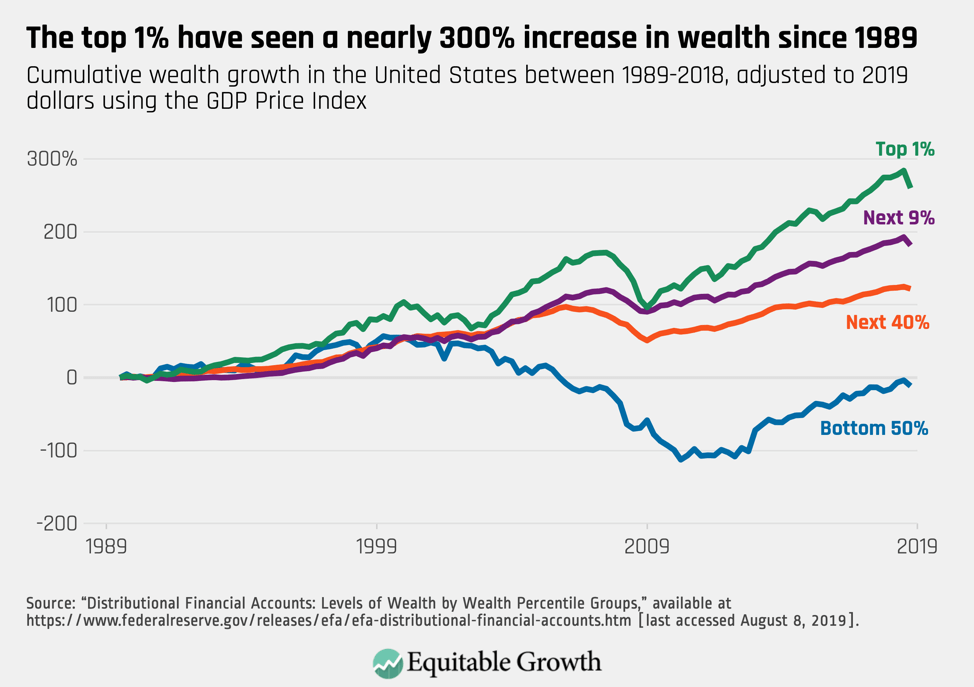
The move away from defined benefit pension plans to defined contribution plans has coincided with stagnant wage growth and no growth in wealth for roughly half the U.S. population. The impact is devastating. How can anyone expect these individuals to...
Can we all be wrong?
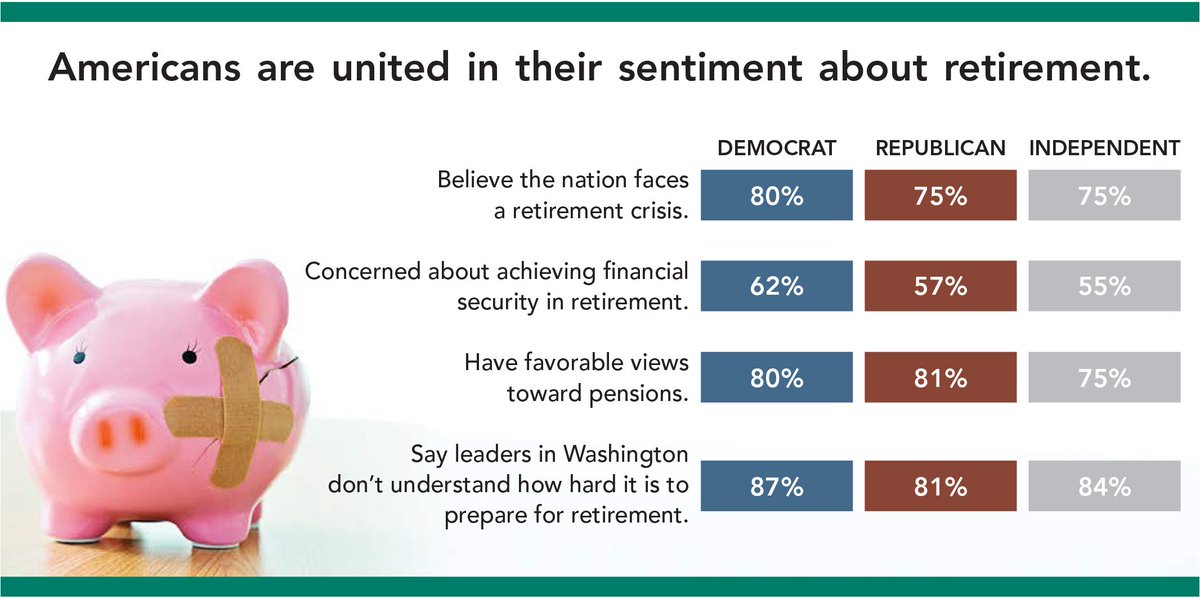
The following information was provided by the National Institute on Retirement Security. It clearly demonstrates that retirement security is not and should not be a political issue. Most Americans have suffered from weak real wage growth for decades. As a...
The following information was provided by the National Institute on Retirement Security. It clearly demonstrates that retirement security is not and should not be a political issue. Most Americans have suffered from weak real wage growth for decades. As a result, they are having great difficulty building the necessary retirement nest egg. Congress has the opportunity to secure the pensions for millions of Americans at this time. Will they continue to let ideology dictate the path forward or will they finally do what is best for the people that they represent?
Time Is Running Out
One of the true positives for me in getting involved in the Butch Lewis Act legislation (H.R. 397) has been meeting (through social media) passionate advocates for pension reform such as John C. Anderson, a retired member of the teamsters,...
One of the true positives for me in getting involved in the Butch Lewis Act legislation (H.R. 397) has been meeting (through social media) passionate advocates for pension reform such as John C. Anderson, a retired member of the teamsters, who constantly provides important updates on their legislative initiatives. John has recently posted this update:Actually there are THREE Newly Applied Funds seeking Reductions that are "In Review"...#1..ROOFERS Local #42...https://www.treasury.gov/…/Composition-Roofers-Local-42-Pen…#2..IBEW Local # 237...https://www.treasury.gov/…/IBEW-Local-237-Pension-Fund-Seco… (Has Applied Twice Now)#3..SHEET METAL LOCAL FUND Troy MI...https://www.treasury.gov/…/Sheet-Metal-Workers-Local-Pension… (Had applied previously a year ago March, then 'Withdrew')It is truly unfortunate that these struggling plans are filing for benefit relief at this time. I realize that the legislative process has moved at a snail's pace, but I remain hopeful that Congress finally understands the severity of their inaction. Let's hope that the above referenced plans can hold off a little longer. Although the proposed legislation calls for reinstituting the benefits previously cut through MPRA, there is significant cost associated with going through the process, and these plans, the employees, and employers cannot afford any more cost that further impacts their funded status.Despite my comment regarding the Senate's acknowledgment that something needs to be done, I still believe that ideological differences among the parties will lead to proposed legislation that has the potential to do more harm than good, while costing more than the implementation of H.R. 397.
It is Awful!
In a follow-up to our August 2nd post titled, "OPEBS - Just How Awful is the funding Issue?" I've come across some excellent work by the folks at Milliman, who have produced the following graph. The funded ratios for the...
In a follow-up to our August 2nd post titled, "OPEBS - Just How Awful is the funding Issue?" I've come across some excellent work by the folks at Milliman, who have produced the following graph.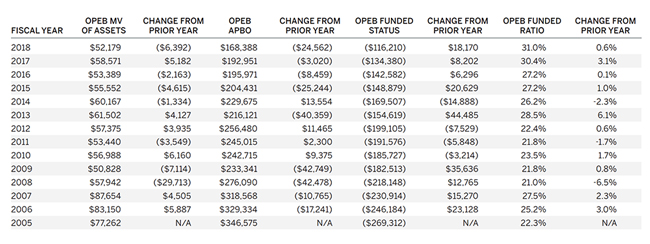 The funded ratios for the OPEBs of their corporate 100 index are atrocious. They even make the funded ratios for public pension systems look healthy! This information masks the fact that several entities have funded ratios that are much poorer than the average. I can only imagine the current status for many of our larger cities.
PRTs Remain All The Rage!
A LIMRA Secure Retirement Institute (SRI) study "finds 8 in 10 private-sector DB plan sponsors (who also offer a defined contribution plan) are at least somewhat interested in a pension risk transfer transaction (PRT). Four in 10 plan sponsors say...
A LIMRA Secure Retirement Institute (SRI) study "finds 8 in 10 private-sector DB plan sponsors (who also offer a defined contribution plan) are at least somewhat interested in a pension risk transfer transaction (PRT). Four in 10 plan sponsors say they are very interested in PRT, marking a 12 percentage-point increase from plan sponsors surveyed in 2014."What is driving this interest? Cost! Benefit plan sponsors are increasingly concerned about the cost of providing a retirement benefit. We know the trend has been for private plans to be shuttered, and according to the study, 46% of the companies that offer both a DB and DC vehicle have frozen their DB plan.The pace of PRTs has accelerated in the last 18 months. What had been a strategy dominated by the big boys - Verizon, GM, AT&T, etc - has now migrated to small and midsized plans. SRI indicates that more than $1 billion in the last 18 months and the number of contracts has increased 76% from 2014.But, we at Ryan ALM feel that the PRT transactions can be expensive. In fact, when comparing PRTs to a cash flow matching strategy for the 1-5 year liabilities a plan sponsor can save an estimated 3%-4% relative to the PRT cost. If longer-dated liabilities are also being immunized, the savings can be closer to 10% to 12%. That is quite a savings in $ terms on that >$1 billion in transactions. Please reach out to us if you'd like to get a better feel for how the savings are achieved.